|
 |
 |
 |
 |
 |
 |
 |
 |
 |

| . |  |
. |
The Building Blocks Of Earth Are Iron
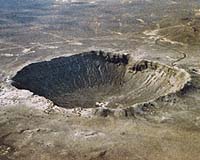
San Antonio TX (SPX) Feb 20, 2006 Iron meteorites are probably the surviving fragments of the long-lost asteroid-like bodies that formed the Earth and other nearby rocky planets, according to researchers from Southwest Research Institute (SwRI) and Observatoire de la Cote d'Azur in Nice, France. Their findings are described in the Feb.16 issue of Nature. Iron meteorites, which are composed of iron and nickel alloys, represent some of the earliest material formed in the solar system, with most coming from the cores of small asteroids. According to Dr. William Bottke, an SwRI research scientist and leader of the joint U.S.-French team, iron-meteorite parent bodies probably emerged from the same disk of planetary debris that produced the Earth and other inner solar system planets. "Small bodies that form quickly in the inner solar system end up melting and differentiating from the decay of short-lived radioactive elements," explains Bottke. "Iron meteorites came from the molten material that sinks to the center of these objects, cools and solidifies." For these meteorites to arrive on Earth, they must have been extracted from their parent bodies and kept around for billions of years. The team's computer simulations found that any asteroids managing to avoid being gobbled up by the planets were quickly demolished by impacts. Each breakup, however, produces millions of fragments, many in the form of iron meteorites. These leftovers were scattered across the solar system by gravitational interactions with protoplanetary bodies, with some reaching the relative safety of the asteroid belt. Over billions of years, a few of the survivors escaped their captivity in the asteroid belt and were delivered to Earth. "This means that certain iron meteorites may tell us what the precursor material for the primordial Earth was like, while also helping us unlock several fundamental questions about the Earth's origins," says Bottke. "There's also the possibility that larger versions of this material may still be hiding among the asteroids. The hunt for them is on."
A new way to look at iron meteorites A potential problem in using meteorites to understand the formation of Earth and other terrestrial planets Mercury, Venus and Mars is that most come from the distant asteroid belt. This population of interplanetary bodies, ranging from tiny pebbles to Texas-sized objects, is located between the orbits of Mars and Jupiter about 140 million miles from Earth. Most members of the asteroid belt are assumed to have formed there, so the vast majority of meteorite samples tell us about formation events in that region, not those that took place near Earth. Meteorite compositions are so diverse, however, that it is difficult to reconcile that all came from this one, fairly narrow region of space. "While tens of thousands of stony meteorites have been collected, most can be traced back to perhaps a few tens of parent asteroids," says Dr. Alessandro Morbidelli of the Observatorie de la Cote d'Azur. "What is strange is that the iron meteorites, despite their smaller numbers, represent almost two-thirds of all of the unique parent asteroids sampled to date." To explain this discrepancy, the team tracked the origin and evolution of iron-meteorite parent bodies using several computer models. They found that while many iron meteorites are likely residing in the asteroid belt today, their precursors probably did not form there. Instead, the simulations indicate that the precursors of most iron meteorites formed in the terrestrial planet region. To investigate this hypothesis, the researchers first examined the constraints provided by the meteorites themselves. Iron meteorites are unusual in that most come from the disrupted cores of small melted (differentiated) asteroids that formed very early in solar system history. These are precisely the kinds of bodies that computer models predict should have formed near Earth. "It is hard to produce small differentiated bodies in the asteroid belt without also melting lots of large asteroids," explains Dr. Robert Grimm, assistant director of the SwRI Space Studies Department. "These events would produce a number of telltale signs that would be easily detected by observers." Using computer simulations, the team then tracked how a disk of asteroid-like bodies interacting with a host of protoplanetary objects in the terrestrial planet region might evolve. Simulations showed that some of these asteroid-like bodies could have scattered far enough to take up residence in the asteroid belt. "While the amount of material reaching the asteroid belt was limited, much of it was placed in regions likely to produce meteorites," says SwRI Research Scientist Dr. David Nesvorn�. En route to the asteroid belt, the parent bodies of the iron meteorites were repeatedly bashed by other bodies, allowing core fragments from numerous bodies to escape. "This could explain the many differences seen among iron meteorites," says Dr. David O'Brien of the Observatoire de la Cote d'Azur. Related Links Southwest Research Institute Observatoire de la Cote d'Azur
 Oxygen in Ancient Atmosphere Rose Gradually To Modern Levels
 College Park MD (SPX) Dec 03, 2005
The history of life on Earth is closely linked to the appearance of oxygen in the atmosphere. The current scientific consensus holds that significant amounts of oxygen first appeared in Earth's atmosphere some 2.4 billion years ago, with a second large increase in atmospheric oxygen occurring much later, perhaps around 600 million years ago. |
|
|

| The content herein, unless otherwise known to be public domain, are Copyright 1995-2006 - SpaceDaily.AFP and UPI Wire Stories are copyright Agence France-Presse and United Press International. ESA PortalReports are copyright European Space Agency. All NASA sourced material is public domain. Additionalcopyrights may apply in whole or part to other bona fide parties. Advertising does not imply endorsement,agreement or approval of any opinions, statements or information provided by SpaceDaily on any Web page published or hosted by SpaceDaily. Privacy Statement |