| . |  |
. |
| . | |
. |


The Art Of Deep Space
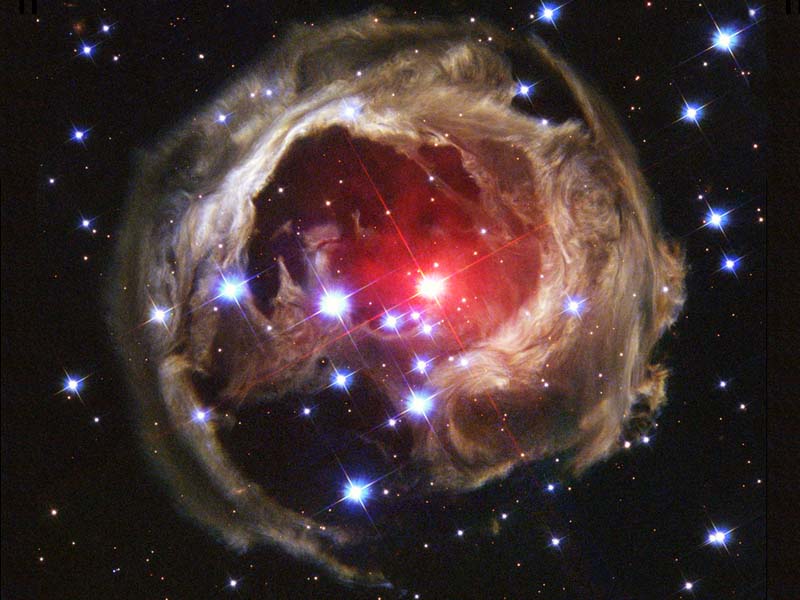
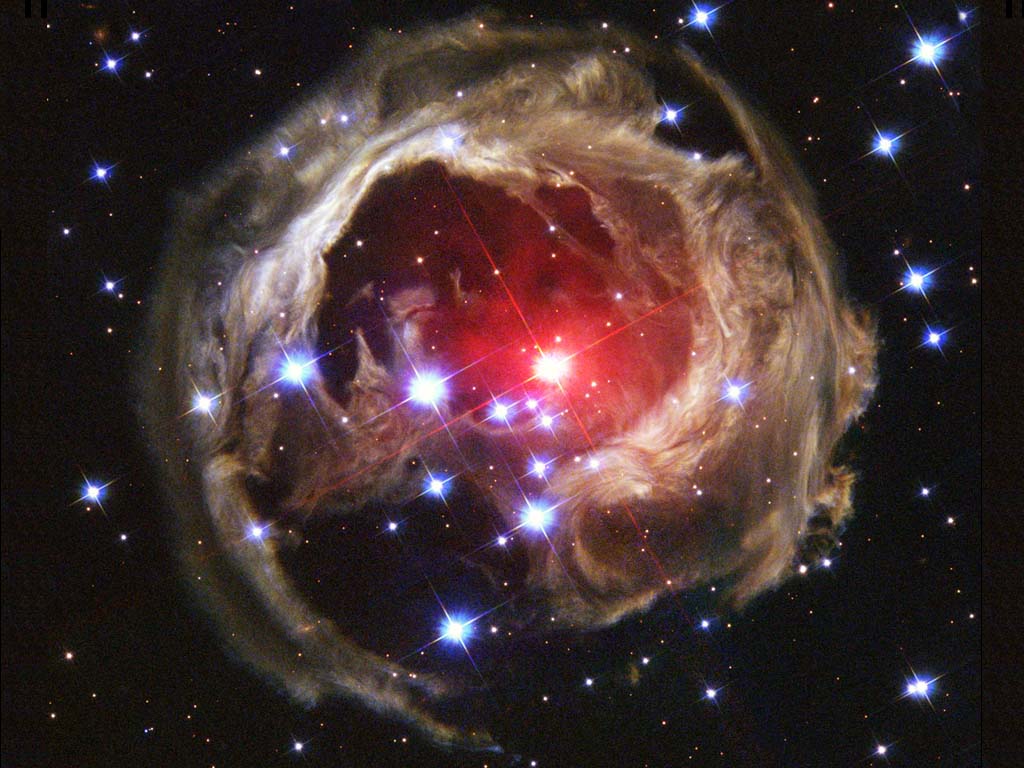
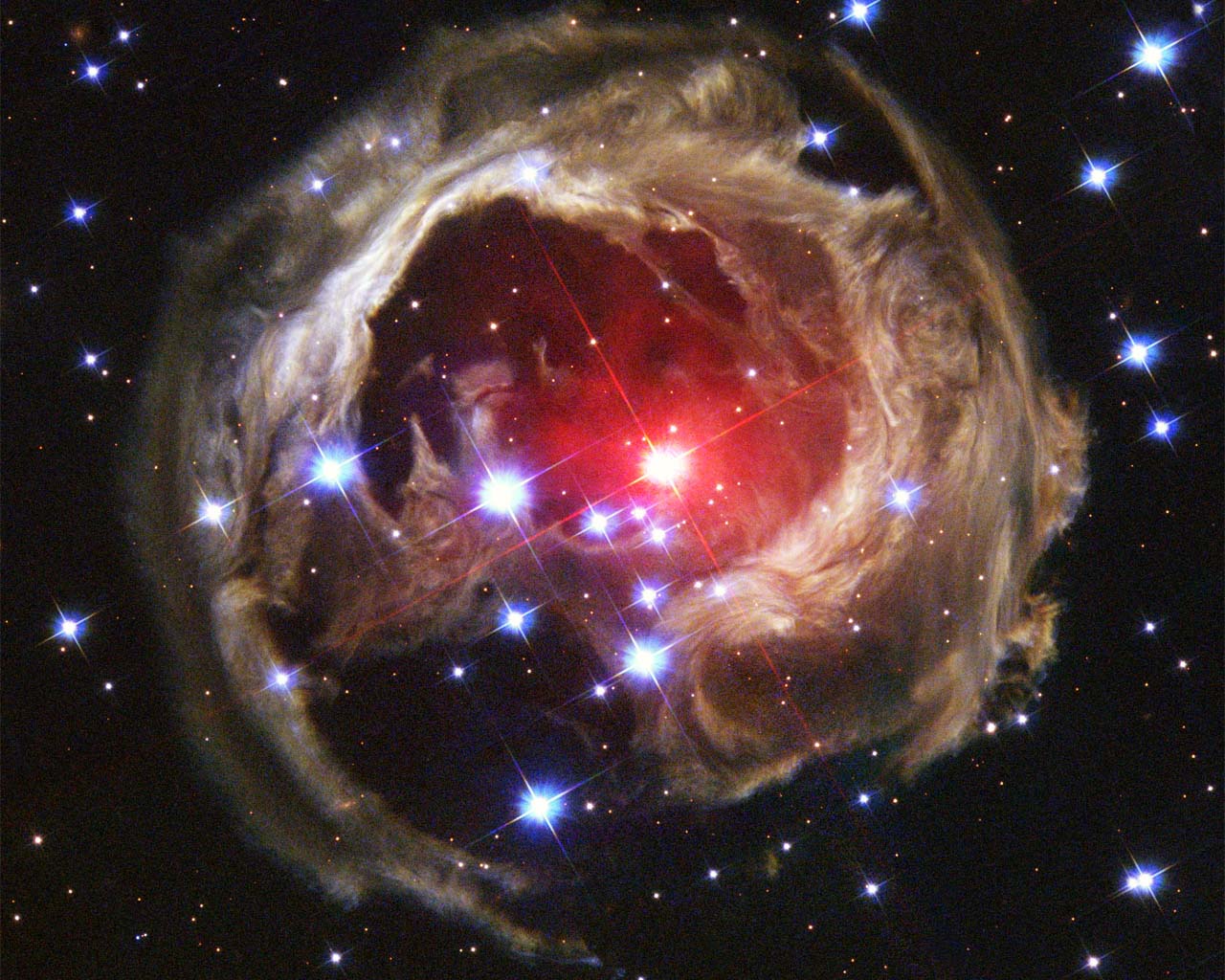
Baltimore - Mar 08, 2004 "Starry Night", Vincent van Gogh's famous painting, is renowned for its bold whorls of light sweeping across a raging night sky. Although this image of the heavens came only from the artist's restless imagination, a new picture from the NASA/ESA Hubble Space Telescope bears remarkable similarities to the van Gogh work, complete with never-before-seen spirals of dust swirling across trillions of kilometres of interstellar space. This image, obtained with the Advanced Camera for Surveys on February 8, 2004, is Hubble's latest view of an expanding halo of light around a distant star, named V838 Monocerotis (V838 Mon). The illumination of interstellar dust comes from the red supergiant star at the middle of the image, which gave off a flashbulb-like pulse of light two years ago. V838 Mon is located about 20,000 light-years away from Earth in the direction of the constellation Monoceros, placing the star at the outer edge of our Milky Way galaxy. Called a light echo, the expanding illumination of a dusty cloud around the star has been revealing remarkable structures ever since the star suddenly brightened for several weeks in early 2002. Though Hubble has followed the light echo in several snapshots, this new image shows swirls or eddies in the dusty cloud for the first time. These eddies are probably caused by turbulence in the dust and gas around the star as they slowly expand away. The dust and gas were likely ejected from the star in a previous explosion, similar to the 2002 event, which occurred some tens of thousands of years ago. The surrounding dust remained invisible and unsuspected until suddenly illuminated by the brilliant explosion of the central star two years ago. The Hubble Space Telescope has imaged V838 Mon and its light echo several times since the star's outburst in January 2002, in order to follow the constantly changing appearance of the dust as the pulse of illumination continues to expand away from the star at the speed of light. During the outburst event, the normally faint star suddenly brightened, becoming 600,000 times more luminous than our Sun. It was thus one of the most luminous stars in the entire Milky Way, until it faded away again in April 2002. The star has some similarities to a class of objects called "novae," which suddenly increase in brightness due to thermonuclear explosions at their surfaces; however, the detailed behavior of V838 Mon, in particular its extremely red color, has been completely different from any previously known nova. Nature's own piece of performance art, this structure will continue to change its appearance in coming years as the light from the stellar outburst continues to propagate outward and bounce off more distant black clouds of dust. Astronomers expect the echoes to remain visible for at least the rest of the current decade. The colour image is composed of 3 different exposures through a blue filter (5250 seconds), a green filter (1050 seconds) and a near-infrared filter (300 seconds). Related Links Hubble SpaceDaily Search SpaceDaily Subscribe To SpaceDaily Express
 A Close Encounter With Jupiter
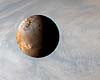 Huntsville - Mar 04, 2004
Lately Earth and Jupiter have been approaching one another, and this week the two worlds are only 400 million miles apart. That's what astronomers call "a close encounter."
--------------------------------------------------------- It's new. And it's downright terrific! Celestron's CPC Schmidt-Cassegrain telescope is the scope you've been waiting for! It offers new alignment technology, advanced engineering, and bold new design at a new, low price! In fact, Celestron's Professional Computerized (CPC) scope with revolutionary SkyAlign Alignment Technology redefines everything that amateur astronomers are looking for. It offers quick and simple alignment, GPS technology, unsurpassed optical quality, ease of use, advanced ergonomics, enhanced computerization and, most important, affordability. Want to view M-31 tonight? One button takes you there!
Shop for telescopes online at Telescopes.com! today!
|
|
|

| The content herein, unless otherwise known to be public domain, are Copyright 1995-2006 - SpaceDaily.AFP and UPI Wire Stories are copyright Agence France-Presse and United Press International. ESA PortalReports are copyright European Space Agency. All NASA sourced material is public domain. Additionalcopyrights may apply in whole or part to other bona fide parties. Advertising does not imply endorsement,agreement or approval of any opinions, statements or information provided by SpaceDaily on any Web page published or hosted by SpaceDaily. Privacy Statement |