| . |  |
. |
| . | |
. |


 by Staff Writers Canberra, Australia (SPX) Mar 14, 2019
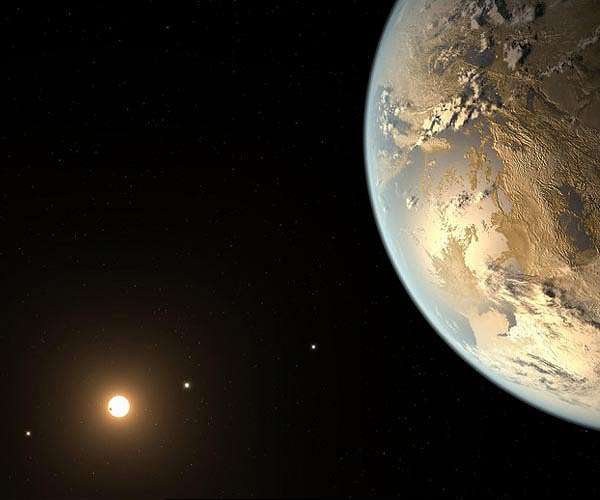
A study by scientists at The Australian National University (ANU) on the magnetic fields of planets has found that most planets discovered in other solar systems are unlikely to be as hospitable to life as Earth. Plants and animals would not survive without water on Earth. The sheer strength of Earth's magnetic field helps to maintain liquid water on our blue planet's surface, thereby making it possible for life to thrive. Scientists from the ANU Research School of Astronomy and Astrophysics modeled the magnetic fields of exoplanets - planets beyond our solar system - and found very few have a magnetic field as strong as Earth. They contend that techniques for finding exoplanets the size of Earth are more likely to find slowly rotating planets locked to their host star in the same way the Moon is locked to Earth, with the same side always facing their host star. The lead author of the study, PhD scholar Sarah McIntyre, said strong magnetic fields may be necessary to keep wet rocky exoplanets habitable. "Magnetic fields appear to play an essential role in making planets habitable, so I wanted to find out how Earth's magnetic field compared to those of other potentially habitable planets," she said. Ms. McIntyre said Earth's strong magnetic field had probably played an important role in protecting the atmosphere from the solar wind and keeping the planet wet and habitable. "Venus and Mars have negligible magnetic fields and do not support life, while Earth's magnetic field is relatively strong and does," she said. "We find most detected exoplanets have very weak magnetic fields, so this is an important factor when searching for potentially habitable planets." Associate Professor Charley Lineweaver, a co-author, said scientists had detected hundreds of rocky exoplanets during the past decade. "Do any of these planets have water on their surfaces? Do they harbor life?" Associate Professor Lineweaver said. "To help answer these questions, we decided to model their magnetic fields. Strong magnetic fields could protect and preserve a wet surface in a way that weak fields cannot." Co-researcher Associate Professor Michael Ireland said finding planets with strong magnetic fields was critical to the search for life elsewhere in the universe. "Finding and characterising planets most likely to be wet and temperate will require ambitious yet feasible space missions," he said.
Research Report: "Planetary Magnetism as a Parameter in Exoplanet Habitability,"
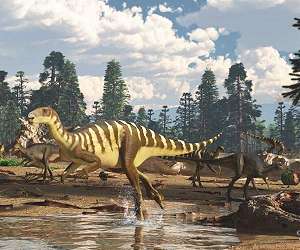
New wallaby-sized dinosaur from the ancient Australian-Antarctic rift valley Cambridge UK (SPX) Mar 13, 2019 A new, wallaby-sized herbivorous dinosaur has been identified from five fossilized upper jaws in 125 million year old rocks from the Cretaceous period of Victoria, southeastern Australia. Reported in the Journal of Paleontology, the new dinosaur is named "Galleonosaurus dorisae," and is the first dinosaur named from the Gippsland region of Australia in 16 years. According to Dr Matthew Herne, a Postdoctoral Fellow at the University of New England, NSW, and lead author of the new study, "the jaws o ... read more
|
|||||||||||||
| The content herein, unless otherwise known to be public domain, are Copyright 1995-2026 - SpaceDaily. All websites are published in Australia and are solely subject to Australian law and governed by Fair Use principals for news reporting and research purposes. By using our websites you consent to cookie based advertising. If you do not agree with this then you must stop using the websites from May 25, 2018. Privacy Statement. Additional information can be found here at About Us. |

 del.icio.us
 Digg
Digg Reddit
 Google







