| . |  |
. |
| . | |
. |


Take A Christmas Break On Mars This Year
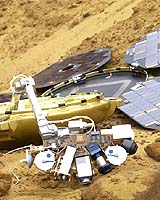
Huntsville - Dec 18, 2003 It's wintertime in the northern hemisphere of Mars, and a flying saucer is about to land. Back on Earth where it comes from, the craft is known as the Beagle 2, sent to Mars by the European Space Agency in search of life. More accurately, the Beagle 2 will be looking for chemical traces of life--telltale signs that life once existed, or perhaps, exists right now on the red planet. Touchdown is scheduled for Christmas Day 2003. The Beagle 2 will precede two NASA rovers, Spirit and Opportunity, slated to land in January. Named after the ship that carried Charles Darwin, the Beagle 2 is a self-contained laboratory shaped like a saucer, or a pocket watch, about three feet in diameter. Although it carries many powerful scientific tools, it weighs a mere 70 pounds. Being so light and compact, the Beagle 2 was able to hitch a ride to Mars onboard the ESA's Mars Express spacecraft launched last June. While Mars Express, an orbiter, surveys the planet from a few hundred miles up, the Beagle 2 will be able to stick its devices right into Mars, sampling rocks and soil on the surface and below. NASA's Everett Gibson, the interdisciplinary scientist for the Mars Express/Beagle 2 mission, explains: "We have two [ways] to get samples: a rock abrasion tool, and a burrowing mole." Both are embedded in the Beagle's robotic arm. "The rock abrasion tool goes right up against a rock, removes its weathered surface, and can continue to go in and take out a little core--about 20 to 100 milligrams of sample," he says. The ability to remove the surface of a rock is important, as scientists learned when NASA's Sojourner rover scrutinized Mars rocks in 1997. They all looked much the same because their surfaces had been weathered by dusty winds and solar radiation. Beagle 2 will be able to sample the variety that lies within. The other tool, "the mole," is able to reach as far as two meters from the Beagle 2 and drill down about one and a half meters, gathering samples in its hollow mouth. Just like the core samples collected from inside rocks, Everett explains, soil found underground will have been shielded from, and less altered by, solar ultraviolet radiation. In these more protected samples, indications of life may be more likely to exist. As samples are collected, they'll be brought back into the Beagle and heated in one of the lab's ovens. Gases released by this process will be analyzed by a mass spectrometer. The Beagle will check for biological signatures by, in part, looking carefully at the types of carbon that it finds. Basically, carbon comes in both a lighter variety -- carbon-12 -- and a heavier variety -- carbon-13. On Earth, things that are alive tend to prefer the lighter kind. They use more carbon-12 in their metabolism. If the spectrometer identifies a sample containing more carbon-12 than would be expected in an inorganic sample of soil, that might be a sign that life had once dwelled there. The spectrometer will also check the atmosphere for traces of methane. This gas can be produced by living creatures. On Earth it comes from sources such as termites, cows, and swamps; on Mars it might come from extreme-loving microbes. Methane on Mars should be destroyed quickly, probably within a matter of months, by the planet's strong ultraviolet radiation. This means that if Beagle 2 detects any methane, something must have created it very recently. If the Beagle 2 can find methane, says Gibson, "it will go a long way to answering that key question: Are biological processes operating on Mars?" On December 19, the Mars Express orbiter will eject the Beagle. From then on, the little laboratory is on its own. On Christmas Day it will hit the Martian atmosphere at a speed of about 12 thousand miles per hour. The resistance of the atmosphere will begin to slow it down, as a shield protects it from the heat of descent. A series of parachutes will emerge, each slowing the Beagle even more. At 200 meters above the surface, three gas-filled airbags will inflate to cushion its landing. The Beagle is expected to touch down within the Isidis Planitia Basin. The landing site is at a low enough elevation to allow Mars' thin atmosphere enough time to slow the Beagle down. There are also some indications that Isidis Planitia contains ice, making it a promising place to look for signs of life. Once the Beagle lands, it will open up, like a pocket watch. Four solar panels will emerge, and begin charging its batteries. It will send a signal saying that it's arrived. "When the Beagle lands," says Gibson, "we won't know immediately, because we have to wait till Odyssey passes over." Odyssey is a NASA spacecraft that's been orbiting Mars for the past two years. "The signal from the Beagle will hopefully be detected by Odyssey," says Gibson. Odyssey will send that signal on. And, about four to six hours after the Beagle lands, its first message should reach the Earth--hopefully the first of many. The Beagle will continue its mission for about six months, collecting data and transmitting it back to Earth via the orbiters Mars Express and Odyssey. Related Links Beagle 2 SpaceDaily Search SpaceDaily Subscribe To SpaceDaily Express
 Speedera To Stream European Space Agency's Mars Express Christmas Landing
 Santa Clara - Dec 18, 2003
Speedera Networks, a leading global provider of on-demand distributed application and content delivery services, and Capcave, an Internet systems integrator based in the Netherlands, today announced that the two organizations are working directly with the European Space Agency (ESA) to provide live streaming of the Mars Express probe scheduled to arrive on Mars at Christmas. |
|
|

| The content herein, unless otherwise known to be public domain, are Copyright 1995-2006 - SpaceDaily.AFP and UPI Wire Stories are copyright Agence France-Presse and United Press International. ESA PortalReports are copyright European Space Agency. All NASA sourced material is public domain. Additionalcopyrights may apply in whole or part to other bona fide parties. Advertising does not imply endorsement,agreement or approval of any opinions, statements or information provided by SpaceDaily on any Web page published or hosted by SpaceDaily. Privacy Statement |