| . |  |
. |
| . | |
. |


TIMED Celebrates 5-Year Anniversary
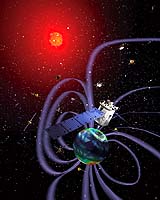
Laurel MD (SPX) Dec 12, 2006 NASA's TIMED (Thermosphere, Ionosphere, Mesosphere Energetics and Dynamics) mission, operated by the Johns Hopkins University Applied Physics Laboratory (APL), celebrated its 5th launch anniversary on Dec. 7, 2006, and its many contributions enabling a greater understanding of Earth's upper atmosphere. Several sessions at the fall 2006 American Geophysical Union conference in San Francisco, Calif., Dec. 11-15, are showcasing TIMED observations and how this mission, in coordination with a network of space- and ground-based systems, has provided the first view of the mesosphere, ionosphere and thermosphere as a coupled system throughout a range of solar activity levels. TIMED was launched on Dec. 7, 2001, during solar maximum (the busiest period during the 11-year cycle of solar activity) and has collected data through the declining phase and into solar minimum. "One of TIMED's main science goals is to understand the energetics of the ionosphere, thermosphere and mesosphere region," says Sam Yee, TIMED project scientist from APL. Originally a 2-year mission, TIMED has been extended for the second time since its launch, with operations and data analysis continuing through 2010. TIMED's continued study of solar effects on our atmosphere will also help set the stage for future NASA Heliophysics missions, such as those within its Living With a Star program that focus on better understanding the sun's effects on life and society. "TIMED has served as a catalyst for a greater understanding of our thermosphere and ionosphere," says Larry Paxton, APL's project scientist for TIMED's Global Ultraviolet Imager (GUVI). "It exists at a time of unprecedented resources such as NASA's Heliophysics Great Observatory (a collection of NASA's sun-Earth-focused missions, which includes TIMED) and an extensive international ground-based instrument network," he says. "TIMED has shown that a low-cost mission can make a contribution to our understanding of the global ionosphere-thermosphere system." TIMED's long-term study of our middle and upper atmosphere (the mesosphere and lower thermosphere/ionosphere) will help scientists better understand this atmospheric region's variability and its effects on communications, satellite tracking, spacecraft lifetimes, degradation of spacecraft materials, and on the reentry of piloted vehicles. Since launch TIMED has collected various measurements showing how different parts of Earth's atmosphere reacts to an array of solar activity, including a total solar eclipse in spring 2006 (see full story at http://www.jhuapl.edu/newscenter/pressreleases/2006/060524b.asp). TIMED data has also shown similarities between the atmospheres of Earth and Mars when compared to ionospheric data sets acquired in 2003 by NASA's Mars Global Surveyor (http://www.jhuapl.edu/newscenter/pressreleases/2006/060524c.asp). In 2004 TIMED captured a glimpse of an auroral display that dipped as far south as Alabama (http://www.timed.jhuapl.edu/WWW/science/scienceHighlights/SHArticles/unCategorized/SH_lightShow.php). It recorded our atmosphere's response, in 2003, to some of the largest geomagnetic storms on record (http://www.timed.jhuapl.edu/WWW/science/scienceHighlights/SHArticles/unCategorized/SH_120803.php). And in 2002, TIMED observed our atmosphere's response to a series of strong solar storms, providing important new information on the final link in the Sun-Earth Connection (SEC) chain of physical processes connecting the sun and Earth (http://www.jhuapl.edu/newscenter/pressreleases/2002/020528.htm). NASA Goddard Space Flight Center manages the TIMED mission. APL, in Laurel, Md., leads the project's science effort and manages the mission's Science Data Center. Related Links Johns Hopkins University Applied Physics Laboratory TIMED at AGU The Air We Breathe at TerraDaily.com
 Steering Clear Of Icy Skies
 Boulder CO (SPX) Dec 01, 2006
Beginning December 6, aviation weather users will receive detailed updates on in-flight icing, which can endanger commuter planes and larger commercial aircraft. Graphical displays, developed by researchers at the National Center for Atmospheric Research (NCAR), will for the first time rate areas by icing severity and the probability of encountering icing conditions. |
|
|

| The content herein, unless otherwise known to be public domain, are Copyright 1995-2006 - SpaceDaily.AFP and UPI Wire Stories are copyright Agence France-Presse and United Press International. ESA PortalReports are copyright European Space Agency. All NASA sourced material is public domain. Additionalcopyrights may apply in whole or part to other bona fide parties. Advertising does not imply endorsement,agreement or approval of any opinions, statements or information provided by SpaceDaily on any Web page published or hosted by SpaceDaily. Privacy Statement |