|
 |
 |
 |
 |
 |
 |
 |
 |
 |

| . |  |
. |
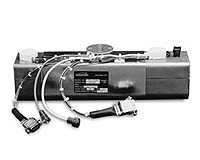
Symmetricom Announces $3.9M Contract Award For ATAFS Program
San Jose CA (SPX) Jun 29, 2005 Symmetricom announced Tuesday that it has been selected as a supplier for the Advanced Technology Atomic Frequency Standard (ATAFS) program, sponsored by the Department of Defense (DOD) Joint Program Office (JPO). The ATAFS program will support development of the next-generation atomic clocks for possible deployment on the Global Positioning System (GPS-III) satellite constellation. Under the contract, awarded by the Space and Missile System Center (SMC) at Los Angeles Air Force Base and valued at $3.9 million, Symmetricom will develop high-performance atomic clocks based on its proprietary optically-pumped cesium beam technology. The contract leverages Symmetricom's extensive atomic clock expertise. "The Advanced Technology Atomic Frequency Standard (ATAFS) development program will emphasize improved frequency stability and integrity of output signal," commented Captain Kristi Lowenthal, program manager for the ATAFS project at the GPS Joint Program Office at Los Angeles Air Force Base. "These technological advancements are critical to future US defense needs as well as improved safety-of-life provisions for the general population." Dr. R. Michael Garvey, chief scientist for Symmetricom's Technology Realization Center commented, "As the provider of the first space borne atomic clocks that demonstrated the capabilities of GPS navigation technology 30 years ago, Symmetricom is uniquely qualified to develop the next generation of long lived, high performance atomic clocks for GPS. Further, our team of scientists and engineers are very excited about the realization of this advanced technology." Cesium atomic clocks are mission-critical references used in government time-keeping, communications and satellite applications, as well as aerospace and telecommunications networks worldwide. Symmetricom pioneered the usage of cesium atomic clocks on board the GPS satellites enabling Full Operational Capability of the GPS System in April 1995. The precision and stability of cesium atomic clock technology is the enabling element in GPS's precision navigation accuracy. The evolution of GPS-based systems has resulted in worldwide access to precision signals used in navigation, telecommunications, safety of life and rescue, surveying, agriculture and a myriad of other applications. Related Links Symmetricom SpaceDaily Search SpaceDaily Subscribe To SpaceDaily Express
 Pitt Researchers See Electron Waves In Motion For First Time
 Pittsburgh PA (SPX) Jun 23, 2005
Both the ancient art of stained glass and the cutting-edge field of plasmonics rely on the oscillation of electrons in nanosized metal particles. |
|
|

| The content herein, unless otherwise known to be public domain, are Copyright 1995-2006 - SpaceDaily.AFP and UPI Wire Stories are copyright Agence France-Presse and United Press International. ESA PortalReports are copyright European Space Agency. All NASA sourced material is public domain. Additionalcopyrights may apply in whole or part to other bona fide parties. Advertising does not imply endorsement,agreement or approval of any opinions, statements or information provided by SpaceDaily on any Web page published or hosted by SpaceDaily. Privacy Statement |