|
 |
 |
 |
 |
 |
 |
 |
 |
 |

| . |  |
. |
Stormy Bands On Ringed World
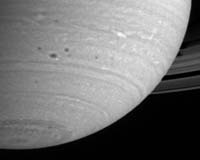
Pasadena (JPL) - May 31, 2004 As Saturn grows closer through the eyes of the Cassini spacecraft, which is hurtling toward a rendezvous with the ringed world on June 30 (July 1, Universal Time), both Cassini and the Earth-orbiting Hubble Space Telescope snapped spectacular pictures of the planet and its magnificent rings. Cassini is approaching Saturn at an oblique angle to the Sun and from below the ecliptic plane. Cassini has a very different view of Saturn than Hubble's Earth-centered view. For the first time, astronomers can compare views of equal-sharpness of Saturn from two very different perspectives. The view from Hubble, taken on March 22, 2004, is so sharp that many individual Saturnian ringlets can be seen. When Cassini returned its picture of Saturn on May 16, it was so close to the planet that the Imaging Science Subsystem narrow-angle camera could not fit the whole planet in its field-of-view. Cassini is still about 12.4 million miles (about 20 million kilometers) away and only 36 days from reaching Saturn. Hubble's exquisite optics, coupled with the high resolution of its Advanced Camera for Surveys, allow it to take pictures of Saturn which are nearly as sharp as Cassini's, even though Hubble is nearly a billion miles farther from Saturn than Cassini. Cassini will ultimately far exceed the resolution of Hubble during its close encounter with Saturn. Cassini's sharpness began to surpass Hubble's when it came to within 14 million miles (23 million kilometers) of Saturn earlier this month. Camera exposures in four filters (blue, blue-green, green, and red) were combined to form the Hubble image, to render colors similar to what the eye would see through a telescope focused on Saturn. The subtle pastel colors of ammonia-methane clouds trace a variety of atmospheric dynamics. Saturn displays its familiar banded structure, and haze and clouds of various altitudes. Like Jupiter, all bands are parallel to Saturn's equator. Even the magnificent rings, at nearly their maximum tilt toward Earth, show subtle hues, which indicate the trace chemical differences in their icy composition. Cassini has two cameras, a wide angle and narrow angle. This narrow angle image was made using a combination of three filters (red, green, blue) and was taken at a range of 15.1 million miles (24.3 million kilometers). The view is from 13 degrees below the equator. Enceladus, one of Saturn's 31 known moons, appears near the south pole at the bottom of the image. The differences between the Hubble and Cassini images are mainly due to the different sets of filters used. Over two decades have passed since a spacecraft last visited Saturn NASA's Voyager-2 flew by Saturn in August 1981. Since 1990, Hubble has produced high-resolution Saturn images, tracking storms and auroral activity while providing crisp views of the rings over time and from various angles. Cassini will begin a four-year mission in orbit around Saturn when it arrives on June 30, 2004 PDT (July 1, 2004 UTC). Six months later it will release its piggybacked Huygens probe for descent through Titan's thick atmosphere. Related Links Saturn at JPL Cassini Imaging Team SpaceDaily Search SpaceDaily Subscribe To SpaceDaily Express
 Cassini Make Tiny Course Change For Saturn
 Washington (SPX) May 31, 2004
The Cassini spacecraft successfully performed a critical six- minute trajectory correction maneuver May 27 to put it on course with its first encounter, Saturn's outermost moon Phoebe, set for June 11. The spacecraft is operating normally and is in excellent health.
--------------------------------------------------------- It's new. And it's downright terrific! Celestron's CPC Schmidt-Cassegrain telescope is the scope you've been waiting for! It offers new alignment technology, advanced engineering, and bold new design at a new, low price! In fact, Celestron's Professional Computerized (CPC) scope with revolutionary SkyAlign Alignment Technology redefines everything that amateur astronomers are looking for. It offers quick and simple alignment, GPS technology, unsurpassed optical quality, ease of use, advanced ergonomics, enhanced computerization and, most important, affordability. Want to view M-31 tonight? One button takes you there!
Shop for telescopes online at Telescopes.com! today!
|
|
|

| The content herein, unless otherwise known to be public domain, are Copyright 1995-2006 - SpaceDaily.AFP and UPI Wire Stories are copyright Agence France-Presse and United Press International. ESA PortalReports are copyright European Space Agency. All NASA sourced material is public domain. Additionalcopyrights may apply in whole or part to other bona fide parties. Advertising does not imply endorsement,agreement or approval of any opinions, statements or information provided by SpaceDaily on any Web page published or hosted by SpaceDaily. Privacy Statement |