| . |  |
. |
| . | |
. |


Space Race 2: Spaceflight Ad Hits TV
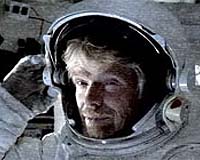
Cape Canaveral FL (UPI) Feb 08, 2005 This weekend's debut of Volvo's beefed-up sport utility vehicle left no doubt the quiet Swedish company, which set the benchmark for auto safety with its line of Earth-shoe-shaped family cars in the 1970s, was ready for a new image. Not only did Volvo choose the most public of venues for its coming-out party - a television ad during last Sunday's Super Bowl - but it also chose as its partner Richard Branson, the maverick, flamboyant, adventure-seeking founder of Virgin Group. Among Branson's ventures is Virgin Galactic, which aims to become the world's first commercial passenger spaceflight service. The raison d'etre for Volvo's foray into Super Bowl advertising? Seventy-seven years after rolling out its first automobiles, the company, now owned by Ford, is offering a V-8 engine, available exclusively in its popular and highly successful SUV, the XC90. Volvo's advertising agency had been thinking of rocket analogies to underscore the vehicle's new oomph, but the ad campaign really blossomed after the successful flights of the world's first privately developed passenger spaceship. SpaceShipOne, built by Burt Rutan's firm, Scaled Composites of Mojave, Calif., with backing from Microsoft co-founder Paul Allen, last year won a $10-million competition for a pair of sub-orbital spaceflights. "One of our clients at Volvo saw that," Christopher Ross, global account director with Euro RSCG Worldwide in New York, told UPI's Space Race 2. "We had been looking for a way to make the ad even more powerful for the Super Bowl." Volvo contacted Virgin and ended up with a deal that is sure to bring the car company flocks of new fans - though perhaps not SUV drivers. In addition to forking over something in the neighborhood of $2 million for the Super Bowl television spot, Volvo is buying a seat aboard a Virgin Galactic flight, which will be given to a sweepstakes winner. As an ad campaign, Bernice Kanner, author of "The Super Bowl of Advertising: How the Commercials Won the Game," rated the Volvo spot "not a zero, but not close to a 10." The 30-second ad, which aired during the game's third quarter, featured close-up, slow-motion shots of an Apollo rocket lifting off the launch pad, interspersed with images of an accelerating eight-cylinder XC90. A narrator notes the XC90 is the only V8 engine with the added power of "the legendary Volvo safety." Answering the question, "How powerful is it?" is a fully suited astronaut who raises his face shied and replies, "Powerful enough to get you into space." The astronaut turns out to be the toothy, hippie-haired Branson himself. "Cars are notoriously hard to advertise," Kanner told Space Race 2, "and Branson doesn't score as well as Donald Trump with the American public." Kanner added he found the launch into space was enigmatic. "I got message of the power, the speed - but the translation (of that) into a car?" The ad ends with the narrator telling viewers to go to boldlygo.com to enter to win a flight on Virgin Galactic. Kanner, a New York marketing guru, pans the notion that a sweepstakes for a ride to space will appeal to the masculine audience Volvo attempted to woo with its Super Bowl spot. "Most men are not that interested," Kanner said. "Just give them a large-screen TV and they would rather watch a rocket launch ... than have to go through training and get inside a little cramped space and be launched themselves." Still, there are at least 18,500 people - some of whom probably do not care a nit about football - who apparently are ready to pay Virgin $200,000 for a three-day training session and a 15-minute rocket ride into sub-orbital space. That is the number of people who have registered to make a deposit for a Virgin Galactic flight, company spokeswoman Jackie McQuillan told Space Race 2. The firm announced in September it had licensed SpaceShipOne technology and hired Rutan to design and build a fleet of commercial spaceliners. Virgin plans to invest about $100 million to develop commercial spaceships and ground-support systems for a sub-orbital space-tourism experience. Volvo is not the first company to launch a giveaway to space. After SpaceShipOne clinched the Ansari X Prize on Oct. 4, 2004, Cadbury Schweppes Americas Beverages of Plano, Texas, unveiled a highly publicized promotion for its 7 UP brand soft drink to award a sub-orbital spaceflight to a sweepstakes winner. The company said details of its promotion would be announced later this year. Randy Gier, marketing head for Cadbury Schweppes, coul d not be reached for comment. Virgin spokeswoman McQuillan said 7 UP has not contacted the company about securing a seat on a Virgin Galactic flight. Other firms, however, including former contenders in the X Prize competition, are developing commercial sub-orbital space-transit systems, though none are thought to be as far along as Virgin, which plans its debut flight within three years. Volvo's sweepstakes rules stipulate that if regularly scheduled commercial flights into sub-orbital space have not begun by March 1, 2009, the ticket to ride, along with up to $100,000 in cash to pay for federal and state taxes on the prize, will be rescinded. Instead, the winner will receive a cash substitute in the amount of $100,000 - enough to buy a pair of Volvo's new luxury SUVs. Space Race 2 is a weekly series exploring the people, passions and business of sub-orbital manned spaceflight, b y Irene Klotz, who covers aerospace for UPI Science News. Email [email protected] Related Links SpaceDaily Search SpaceDaily Subscribe To SpaceDaily Express
 Analysis: A Promising NASA Budget?
 Washington (UPI) Feb 08, 2005
Despite fears by many in the scientific community that President George W. Bush's initiative to re-invigorate the American manned space program would cause deep cuts in NASA's science budget, the administration's proposed 2006 budget - announced with great fanfare on Monday - left almost all of the agency's present science programs in place, while providing increased clarity and focus to its future plans. |
|
|

| The content herein, unless otherwise known to be public domain, are Copyright 1995-2006 - SpaceDaily.AFP and UPI Wire Stories are copyright Agence France-Presse and United Press International. ESA PortalReports are copyright European Space Agency. All NASA sourced material is public domain. Additionalcopyrights may apply in whole or part to other bona fide parties. Advertising does not imply endorsement,agreement or approval of any opinions, statements or information provided by SpaceDaily on any Web page published or hosted by SpaceDaily. Privacy Statement |