| . |  |
. |
| . | |
. |


Scientists Discover New Material That Expands Under Pressure
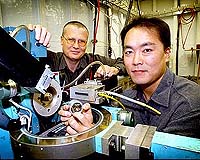
Upton - Dec. 17, 2001 Most materials get compacted or fall apart under pressure, but scientists working in an international collaboration between the U.S. Department of Energy's Brookhaven National Laboratory and the School of Chemical Sciences at England's University of Birmingham have discovered some that expand. These unusual materials may have applications as "molecular sponges" for soaking up chemical pollutants or even radioactive waste. The idea, according to physicist Thomas Vogt, the lead Brookhaven scientist on the study, is that you squeeze a fluid into tiny pores in the material, thereby increasing its volume. This extra volume can also allow slightly larger molecules or atoms, such as pollutants, to enter the expanded pores. "When the pressure is released and the material contracts, the pollutant would be trapped inside," he said. Vogt and his collaborators -- Yongjae Lee, a postdoc at Brookhaven, John Parise, a Stony Brook University chemist, Joseph Hriljac, a chemist at the University of Birmingham, and Gilberto Artioli from the University of Milan in Italy -- describe one such material in an upcoming issue of the Journal of the American Chemical Society. The materials are all zeolites -- solids containing aluminum, silicon, and oxygen with a three-dimensional structure containing regularly spaced pores within the molecular framework. These nanopores (so-called because of their tiny size, on the order of billionths of a meter) make zeolites very useful for sucking up small molecules, ions, or gases -- just like a sponge sucking up water. The pores are normally filled with positively charged ions, such as calcium or sodium, and water molecules. So zeolites are said to be hydrated. Many are currently used as water softeners and in detergents. Previous studies elsewhere suggested that some zeolites have unusual properties under pressure. The collaborative team was investigating these properties when they discovered one zeolite that could suck up twice the normal amount of water -- a superhydrated zeolite. Using a technique called "powder diffraction" at Brookhaven's National Synchrotron Light Source (NSLS), the team has deciphered the zeolite's molecular structure, which for the first time explains this unusual property and shows where the extra water goes. The experiments were done by subjecting the material to increasing pressure (from normal atmospheric pressure up to 50,000 times that pressure) in a diamond anvil cell. Essentially, the sample is squeezed between two diamonds, the world's hardest substance, in a tiny chamber filled with water or another liquid to transmit the pressure evenly to all sides. The scientists then bombard the sample with an intense beam of x-rays and analyze how this beam is diffracted, or bent, as it bounces off the sample. Using computers, Yongjae Lee then translated the diffraction pattern into a three-dimensional molecular structure. As the pressure increased, the material at first appeared to compress, as one would expect. But as the pressure climbed between 0.8 and 1.5 gigapascals (8,000 to 15,000 times atmospheric pressure), the material expanded along two of its three dimensions. "This is not supposed to happen," said Vogt. "Normally, when you squeeze something, it's supposed to get smaller. This stuff gets bigger." When the pressure increased beyond 1.5 gigapascals, the material compressed once again. Analysis of the molecular structure revealed that, during the expansion, extra water molecules were squeezing into the zeolite's pores. The scientists have suggested several ways to exploit the unusual property they call pressure-induced expansion, found in only certain zeolites. One would be to set up a "trap door" mechanism for locking up chemical or radioactive pollutants. "When you increase the pressure and the material gets bigger, the pores get bigger, too," Hriljac said. "So we can try to get bigger ions or molecules in there, such as hydrocarbons, mercury, lead, or even radioactive strontium. Then, when you release the pressure, the pore would get smaller and trap the pollutants inside." The scientists plan to continue their studies on the expanding zeolites to see if this approach will work. Related Links Brookhaven National Laboratory SpaceDaily Search SpaceDaily Subscribe To SpaceDaily Express
 Diesel Soot Added To List Of Global Warming Culprits
 Stanford - Dec 17, 2001
It's dirty, smelly, causes respiratory and cardiovascular disease and shortens life, true, but now there's another reason to hate diesel exhaust: Its soot exacerbates global warming. Reducing soot emissions will slow global warming faster than will reducing carbon dioxide, methane or other greenhouse gases, says a Stanford pollution expert. |
|
|

| The content herein, unless otherwise known to be public domain, are Copyright 1995-2006 - SpaceDaily.AFP and UPI Wire Stories are copyright Agence France-Presse and United Press International. ESA PortalReports are copyright European Space Agency. All NASA sourced material is public domain. Additionalcopyrights may apply in whole or part to other bona fide parties. Advertising does not imply endorsement,agreement or approval of any opinions, statements or information provided by SpaceDaily on any Web page published or hosted by SpaceDaily. Privacy Statement |