| . |  |
. |
| . | |
. |


Russian Rocket To Fly Again Following Crash
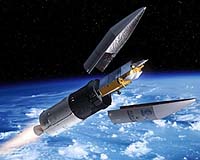
Moscow (AFP) Nov 07, 2005 A ban on further flights of a Russian rocket following last month's crash of a 140-million-euro (170-million-dollar) satellite has been lifted, the launcher's developers said Monday. Russia's Khrunichev space centre said that following an investigation the crash of the CryoSat satellite was not deemed to be attributable to the Rockot launch vehicle, which would no longer be grounded. A statement confirmed that the cause was a failure by the command system to transmit a preliminary order for the second stage's engine to shut down. CryoSat, designed to make very precise measurements of polar ice cap thicknesses, would have been a vital tool for environmental scientists at a time when ice at both poles seems to be shrinking. European Space Agency official Pascal Gilles said immediately after the crash on October 8 that according to the Russians the second stage of the rocket had failed to separate. "The second stage continued to burn after the onboard computer told it shut down. There was no separation between the second and third stages of the rocket, and the third failed to ignite. The whole thing ... fell into the Arctic Ocean," he said. The Rockot launcher used in the mission is a converted Soviet-era SS-19 ballistic missile with an additional Breeze-KM upper stage. Related Links SpaceDaily Search SpaceDaily Subscribe To SpaceDaily Express
 Airlaunch Selected For Contract Continuance By DARPA
 Kirkland WA (SPX) Nov 07, 2005
AirLaunch announced that it has been selected for contract continuance by the Defense Advanced Research Projects Agency (DARPA) under Phase 2B of the Falcon program. |
|
|

| The content herein, unless otherwise known to be public domain, are Copyright 1995-2006 - SpaceDaily.AFP and UPI Wire Stories are copyright Agence France-Presse and United Press International. ESA PortalReports are copyright European Space Agency. All NASA sourced material is public domain. Additionalcopyrights may apply in whole or part to other bona fide parties. Advertising does not imply endorsement,agreement or approval of any opinions, statements or information provided by SpaceDaily on any Web page published or hosted by SpaceDaily. Privacy Statement |