|
 |
 |
 |
 |
 |
 |
 |
 |
 |

| . |  |
. |
Russia's Space Challenge Part 2
UPI Outside View Commentator Moscow (UPI) Oct 25, 2006 Among the problems being addressed by the Russian Space Troops together with the Federal Space Agency (Roskosmos), are delays in the development of advanced systems and their adoption for service, as well as an emerging negative trend in the quality of weapons supplied. Another issue is undoubtedly rigid resource-and population-dictated restrictions that demand new approaches to the technical policy for maintaining and developing space systems and space missile defenses and keeping them ready for use in the state's defense and security interests. It is these restrictions that stand in the way of Russia's ability to tackle all aspects of military space at one go and that have forced it to adopt a phased approach. "There is an imbalance in the development of orbital and ground-based infrastructure; we are increasingly lagging behind the leading world powers, especially the United States, in space control, and have not resolved all matters related to relieving the Space Troops of duties not typical of the state's military complex and handing them over to civilian agencies." Air and space defense is just one of Russia's strategic goals, along with strategic deterrence and general-purpose strategic actions. The 2007-2015 state armaments program has a section dealing with air and space defense until 2016 and beyond. It outlines the main areas and stages of building air and space defenses over the next 20 to 30 years. The concept allocates responsibility for countering air and space attacks of different types and classes to relatively independent but cooperating components of Russia's air and space defense system. It also defines phases of integrative processes to counter potential threats as they develop into real attacks by other states. Concerning further integration of efforts and resources to use space-based systems, we will stick to the principle of reasonable sufficiency. Here it is worthwhile to establish several integrated space systems: reconnaissance, communications and navigational-time and geodetic positioning. These systems act relatively independently in delivering space information to the consumer. Their closer integration is undesirable on cost-effectiveness criteria. Space infrastructure is now increasing its role throughout the world in boosting both the military might and social and economic prosperity of the leading world states. In military matters, space-based systems are the key to information supremacy. They provide more accurate and prompt information about the situation to all troops and weapons systems. Space resources have therefore become a matter of vital interest for the state economically, politically and militarily. The drive to possess these resources and control their use may in the foreseeable future expand the sphere of military operations and move them to outer space. Russia is against this scenario in principle, and is making every effort to prevent its realization. But we, like most of the space powers, are considering methods of protecting our orbital constellations of spacecraft and space resources against possible discriminatory and restrictive moves. If foreign states develop and deploy space-strike infrastructure, Russia must be ready to take adequate defensive and offensive measures. In the field of military space, our emphasis will logically be on unmanned craft. As regards the peaceful uses of space, Russia's federal space program provides for a balanced development of both segments, manned and unmanned. The Space Troops were active in formulating and agreeing on the program's draft, and they continue to contribute to its implementation, notably the International Space Station project. Col. Gen. Vladimir Popovkin is commander of the Space Troops of the Defense Ministry of Russia. This article is reprinted by permission of the RIA Novosti news agency. United Press International's "Outside View" commentaries are written by outside contributors who specialize in a variety of important issues. The views expressed do not necessarily reflect those of United Press International. In the interests of creating an open forum, original submissions are invited.
Source: United Press International Related Links The latest in Military Technology for the 21st century at SpaceWar.com
 Latest Air Force Weather Satellite Ready For Launch
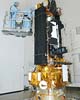 Vandenberg AFB CA (SPX) Oct 27, 2006
The Defense Meteorological Satellite Program (DMSP) F-17 Block 5D-3 spacecraft, built under contract for the U.S. Air Force by Lockheed Martin, is undergoing final preparation for a launch from Vandenberg Air Force Base, Calif. on November 4. |
|
|

| The content herein, unless otherwise known to be public domain, are Copyright 1995-2006 - SpaceDaily.AFP and UPI Wire Stories are copyright Agence France-Presse and United Press International. ESA PortalReports are copyright European Space Agency. All NASA sourced material is public domain. Additionalcopyrights may apply in whole or part to other bona fide parties. Advertising does not imply endorsement,agreement or approval of any opinions, statements or information provided by SpaceDaily on any Web page published or hosted by SpaceDaily. Privacy Statement |