|
 |
 |
 |
 |
 |
 |
 |
 |
 |

| . |  |
. |
Russia And India To Jointly Use Glonass Satellite System
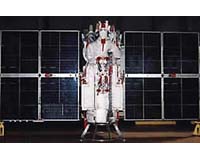
Moscow, Russia (RIA) Oct 04, 2006 Russia and India will use a 24-satellite navigational and global positioning system, Glonass, together, a spokesman for the Russian Federal Space Agency said. "A Russian inter-departmental delegation will arrive in India to coordinate the details October 27," Igor Panarin said. Glonass, a Russian analogue of the United States Global Positioning System, is designed to allow both military and civilian users around the globe to receive signals from satellites to identify their positions in real time. It can also be used in geological prospecting. Panarin said India's access to information from and joint operation of Glonass-M and Glonass-K satellites were discussed on the sidelines of the Space Generation Congress, under way in Valencia, Spain. Two types of satellites are currently in use - Glonass and its updated version Glonass-M. Glonass-M has a longer service life of seven years and is equipped with updated antenna feeder systems, and an additional navigation frequency for civilian users. A future modification, Glonass-K, is an entirely new model. Tests on Glonass-K satellites are scheduled for 2007. They are small spacecraft that are considerably lighter than their previous models, which makes them less costly to put into orbit. Their weight also allows the use of a wider range of carrier rockets. Glonass-Ks' estimated service life has been increased to 10-12 years, and a third "civilian" L-range frequency was added. The Defense Ministry said August 30 Glonass will be fully deployed by 2010, when the number of satellites will be brought from the current 17 to 24. Panarin also said Russia will launch a small research satellite, Youthsat, which is an Indo-Russian project, and an agreement on the matter could be signed in November. "The satellite will be built in India and launched by a Russian carrier rocket," Panarin said. Panarin said Igor Perminov, Federal Space Agency chief, and Madhavan Nair, who heads India's Space Research Organization, met to discuss progress under a contract to supply Russian-made cryogenic engines to India's GSLV geosynchronous launch vehicles. Russia is expected to supply seven cryogenic upper stages to India, which originally wanted to buy the Russian technology to build the engines domestically, but U.S. pressure prevented their delivery. India has been working to develop a cryogenic engine for the past 11 years. Working to cut its dependence on foreign launch vehicles, India has had four operational GSLV flights since 2004 using Russian engines for the upper stage.
Source: RIA Novosti Related Links GPS Applications, Technology and Suppliers
 GIOVE-A Laser Ranging Campaign Successful
 Paris, France (ESA) Oct 04, 2006
Fourteen laser ranging stations participated in a campaign to track ESA's GIOVE-A satellite during the spring and summer of 2006, providing invaluable data for the characterisation of the satellite's on-board clock. The campaign was coordinated by the International Laser Ranging Service (ILRS) and the GIOVE Processing Centre at ESA-ESTEC. |
|
|

| The content herein, unless otherwise known to be public domain, are Copyright 1995-2006 - SpaceDaily.AFP and UPI Wire Stories are copyright Agence France-Presse and United Press International. ESA PortalReports are copyright European Space Agency. All NASA sourced material is public domain. Additionalcopyrights may apply in whole or part to other bona fide parties. Advertising does not imply endorsement,agreement or approval of any opinions, statements or information provided by SpaceDaily on any Web page published or hosted by SpaceDaily. Privacy Statement |