


|
|
|
|
|
|
|
|
|
|
|


| . |  |
. |
|
|
|
 by Staff Writers Gainesville, FL (SPX) Jul 09, 2008
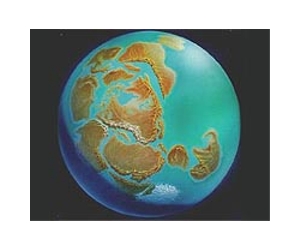
Even in geology, it's not often a date gets revised by 500 million years. But University of Florida geologists say they have found strong evidence that a half-dozen major basins in India were formed a billion or more years ago, making them at least 500 million years older than commonly thought. The findings appear to remove one of the major obstacles to the Snowball Earth theory that a frozen Earth was once entirely covered in snow and ice - and might even lend some weight to a controversial claim that complex life originated hundreds of million years earlier than most scientists currently believe. "In modern geology, to revise the age of basins like this by 500 million years is pretty unique," says Joe Meert, a UF associate professor of geology. Agreed Abhijit Basu, a professor of geological studies at Indiana University: "The required revision is enormous - 500 million years or about 11 percent of total Earth history." Meert is one of eight authors of a paper on the research that recently appeared in the online edition of the journal Precambrian Research. The Purana basins - which include the subject of the study, the Vindhyan basin - are located south of New Delhi in the northern and central regions of India. They are slight, mostly flat depressions in the Earth's crust that span thousands of square miles. For decades, Meert said, most geologists have believed the basins formed 500 million to 700 million years ago when the Earth's crust stretched, thinned and then subsided. Meert said that date may have originated in early radiometric dating of sediment from the basin. Radiometric dating involves estimating age based on the decay or radioactive elements. Additionally, he said, apparent fossils retrieved from the basin seemed to have originated between 500 million and 700 million years ago. The researchers were working on an unrelated project and had no intention of re-examining the basins' age. But then a UF graduate student, Laura Gregory, dated a kimberlite retrieved from the Vindhyan basin to about 1,073 million years ago. A kimberlite is a volcanic rock that contains diamonds. Gregory also used paleomagnetism, a technique that estimates where rocks were formed by using the orientation of their magnetic minerals. Curious about whether the kimberlite results would apply more generally to the region, fellow UF graduate student Shawn Malone compared the kimberlite's orientation to other rocks from the Vindhyan basin. To his surprise, he found the orientations were virtually identical. As a result, the geologists expanded the investigation, using a modified chain saw to drill wine-cork-sized cores out of dozens of rocks collected from 56 sites. Their contents all also had the same or very similar magnetic orientation, Meert said. Much of the basins are composed of sediments that cannot be dated using any method. But Meert said the sediment also contains zircon, which can be dated using laser mass spectrometry - vaporizing tiny bits of the rocks with a laser, then analyzing their uranium and "daughter" lead contents to tease out their formation date based on rates of decay. All the zircon the researchers tested originated 1,020 million years ago, Meert said. The Snowball Earth theory posits that the Earth was covered in snow and ice from about 635 million to 700 million years ago. While much geological evidence has been found to support that theory worldwide, the Vindhyan and other Purana basins lacked numerous telltale signs, such as striated or scratched boulders formed when ice drags small pebbles over bedrock and boulder beds derived from glaciers known as tillites, Meert said. As a result, he said, the basins represented a prominent obstacle to the theory. The new study removes that obstacle because it pushes back the origins of the basins to well before Snowball Earth would have occurred. A 2007 study, conducted independently of the UF study and published in the Journal of Geology, dated rocks from another Purana basin to 1,020 million years ago, another 500-million-year revision. One of its authors was M.E. "Pat" Bickford, a professor emeritus at Syracuse University's department of earth sciences. Bickford said the revisions of the age of the Purana basins calls into question the hypothesis that they formed when the supercontinent Rodinia broke up. Rodinia is thought to have separated into the modern continents about 700 million years ago, but the revisions make the basins too old for that split, Bickford said. The UF research could also support a Swedish paleontologist's controversial dating of multicellular creatures called Ediacarans from an older part of the basin to 1.6 billion years. But, said Meert, "Of all the implications of this research, the notion that Ediacaran-like organisms may be much older than 580 million years is probably the most speculative." The National Science Foundation funded the UF research.
Related Links University of Florida Explore The Early Earth at TerraDaily.com
|
|
|
| The content herein, unless otherwise known to be public domain, are Copyright 1995-2014 - Space Media Network. AFP, UPI and IANS news wire stories are copyright Agence France-Presse, United Press International and Indo-Asia News Service. ESA Portal Reports are copyright European Space Agency. All NASA sourced material is public domain. Additional copyrights may apply in whole or part to other bona fide parties. Advertising does not imply endorsement,agreement or approval of any opinions, statements or information provided by Space Media Network on any Web page published or hosted by Space Media Network. Privacy Statement |
 del.icio.us
 Digg
Digg Reddit
 Google