


|
|
|
|
|
|
|
|
|
|
|


| . |  |
. |
|
|
|
 by Staff Writers Madison WI (SPX) Jul 01, 2008
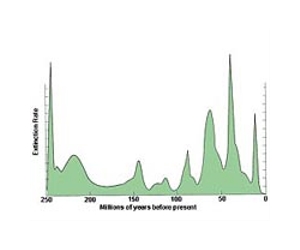
If you are curious about Earth's periodic mass extinction events such as the sudden demise of the dinosaurs 65 million years ago, you might consider crashing asteroids and sky-darkening super volcanoes as culprits. But a new study, published online June 15 in the journal Nature, suggests that it is the ocean, and in particular the epic ebbs and flows of sea level and sediment over the course of geologic time, that is the primary cause of the world's periodic mass extinctions during the past 500 million years. The study highlights the important connections between life on Earth and our planet's changing environment. "The expansions and contractions of those environments have pretty profound effects on life on Earth," says Shanan Peters, a University of Wisconsin-Madison assistant professor of geology and geophysics and the author of the new Nature report. In short, according to Peters, changes in ocean environments related to sea level exert a driving influence on rates of extinction, which animals and plants survive or vanish, and generally determine the composition of life in the oceans. Since the advent of life on Earth 3.5 billion years ago, scientists think there may have been as many as 23 mass extinction events, many involving simple forms of life such as single-celled microorganisms. During the past 540 million years, there have been five well-documented mass extinctions, primarily of marine plants and animals, with as many as 75 to 95 percent of species lost. For the most part, scientists have been unable to pin down the causes of such dramatic events. In the case of the demise of the dinosaurs, scientists have a smoking gun, an impact crater that suggests dinosaurs were wiped out as the result of a large asteroid crashing into the planet. But the causes of other mass extinction events have been murky, at best. "Paleontologists have been chipping away at the causes of mass extinctions for almost 60 years," explains Peters, whose work was supported by the National Science Foundation. "Impacts, for the most part, aren't associated with most extinctions. There have also been studies of volcanism, and some eruptions correspond to extinction, but many do not." Arnold I. Miller, a paleobiologist and professor of geology at the University of Cincinnati, says the new study is striking because it establishes a clear relationship between the tempo of mass extinction events and changes in sea level and sediment: "Over the years,researchers have become fairly dismissive of the idea that marine mass extinctions like the great extinction of the Late Permian might be linked to sea-level declines, even though these declines are known to have occurred many times throughout the history of life. The clear relationship this study documents will motivate many to rethink their previous views." Peters measured two principal types of marine shelf environments preserved in the rock record, one where sediments are derived from erosion of land and the other composed primarily of calcium carbonate, which is produced in-place by shelled organisms and by chemical processes. "The physical differences between (these two types) of marine environments have important biological consequences," Peters explains, noting differences in sediment stability, temperature, and the availability of nutrients and sunlight.In the course of hundreds of millions of years, the world's oceans have expanded and contracted in response to the shifting of the Earth's tectonic plates and to changes in climate. There were periods of the planet's history when vast areas of the continents were flooded by shallow seas, such as the shark- and mosasaur-infested seaway that neatly split North America during the age of the dinosaurs. As those epicontinental seas drained, animals such as mosasaurs and giant sharks went extinct, and conditions on the marine shelves where life exhibited its greatest diversity in the form of things like clams and snails changed as well. The new Wisconsin study, Peters says, does not preclude other influences on extinction such as physical events like volcanic eruptions or killer asteroids, or biological influences such as disease and competition among species. But what it does do, he argues, is provide a common link to mass extinction events over a significant stretch of Earth history. "The major mass extinctions tend to be treated in isolation (by scientists)," Peters says. "This work links them and smaller events in terms of a forcing mechanism, and it also tells us something about who survives and who doesn't across these boundaries. These results argue for a substantial fraction of change in extinction rates being controlled by just one environmental parameter."
Related Links University of Wisconsin-Madison Explore The Early Earth at TerraDaily.com
|
|
|
| The content herein, unless otherwise known to be public domain, are Copyright 1995-2014 - Space Media Network. AFP, UPI and IANS news wire stories are copyright Agence France-Presse, United Press International and Indo-Asia News Service. ESA Portal Reports are copyright European Space Agency. All NASA sourced material is public domain. Additional copyrights may apply in whole or part to other bona fide parties. Advertising does not imply endorsement,agreement or approval of any opinions, statements or information provided by Space Media Network on any Web page published or hosted by Space Media Network. Privacy Statement |
 del.icio.us
 Digg
Digg Reddit
 Google