| . |  |
. |
| . | |
. |


 by Staff Writers Jyvaskylan, Finland (SPX) May 12, 2022
A group of researchers from Pisa, Jyvaskyla, San Sebastian and MIT have demonstrated how a heterostructure consisting of superconductors and magnets can be used to create uni-directional current like that found in semiconductor diodes. These novel superconductor diodes, however, operate at much lower temperatures than their semiconductor counterparts and are therefore useful in quantum technologies.
Electronics for quantum technology This can be understood from the energy gap, which indicates a forbidden region for electronic excitations that form in superconductors. It resembles the energy gap in semiconductors but is typically much smaller. While the presence of such a gap has been known for decades, the diode-like feature has not been previously observed, because it requires breaking the usually robust symmetry of the contact's current-voltage characteristics. The new work demonstrates how this symmetry can be broken with the help of a ferromagnetic insulator suitably placed in the junction. Since a big part of today's research on quantum technologies is based on superconducting materials operating at ultralow temperatures, this innovation is readily available for them.
Power of collaboration "Actually, finding the diode functionality was a pleasant surprise, a consequence of the thorough characterization of SUPERTED samples," explains Elia Strambini, from Istituto Nanoscienze - CNR and Scuola Normale Superiore (SNS) in Pisa, who made the initial discovery. Francesco Giazotto, from Istituto Nanoscienze - CNR and SNS and who led the experimental efforts, says: "I believe this finding is promising for several tasks in quantum technology, such as current rectification or current limiting." SUPERTED coordinator; Professor Tero Heikkila, from the University of Jyvaskyla, worked on the theory behind the effect: "This finding showed the power of collaboration between different types of researchers, from materials science to superconducting electronics and theory. Without European support such collaboration would not take place."
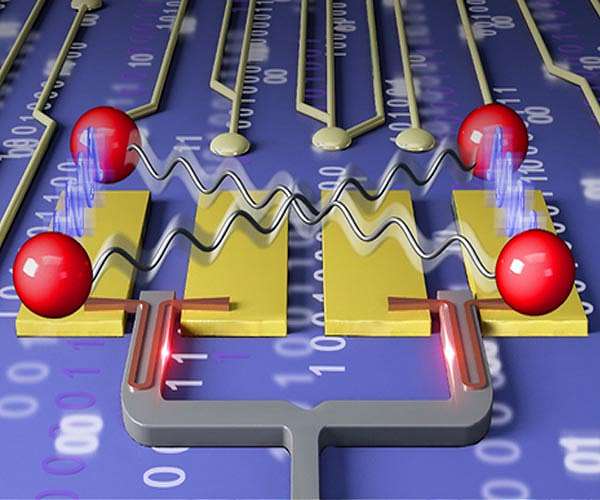
Research Report:Superconducting spintronic tunnel diode (stock illustration only)
Bright, stable, and easy to recycle lighting Munich, Germany (SPX) May 10, 2022 Light-emitting electrochemical cells (LECs) are the simplest and least expensive thin-film lighting devices available to date. They consist of a single active layer. They are used, for example, as electroluminescent inks and stickers. The effect of electroluminescence was first demonstrated in 1905. At that time, two scientists detected the presence of light under applied voltage in various minerals and metals and were able to correlate the intensity to voltage and heat generation. Their prototype ... read more
|
|||||||||||||
| The content herein, unless otherwise known to be public domain, are Copyright 1995-2026 - SpaceDaily. All websites are published in Australia and are solely subject to Australian law and governed by Fair Use principals for news reporting and research purposes. By using our websites you consent to cookie based advertising. If you do not agree with this then you must stop using the websites from May 25, 2018. Privacy Statement. Additional information can be found here at About Us. |

 del.icio.us
 Digg
Digg Reddit
 Google







