| . |  |
. |
| . | |
. |


Raytheon Delivers 2000th Joint Standoff Weapon
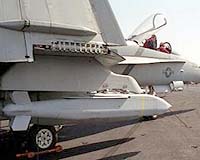
Tucson AZ (SPX) Dec 01, 2005 Raytheon has delivered the 2,000th Joint Standoff Weapon (JSOW), providing the warfighter the ability to use a precision guided air-to-ground weapon while staying out of harm's way. A JSOW-A was shipped to the U.S. Air Force, representing more than 48 months of on time deliveries of JSOW to the U.S. government. Raytheon is under contract with the Naval Air Systems Command to provide JSOW to the U.S. Navy, Marine Corps and Air Force. JSOW deliveries started in 1997 with the first low-rate initial production delivery to the U.S. Navy. "We are proud of our record of four years of on time JSOW production that provides our warfighters with a critical weapon," said Harry Schulte, Strike Weapons vice president at Raytheon Missile Systems in Tucson." This represents a lot of hard work and careful planning by all members of the JSOW team both on the contractor and government side." JSOW production will transition to Block II in 2006, which will significantly lower the unit price of the air-to-ground long-range standoff weapons. Raytheon and the U.S. Navy are also starting development of a Block III variant of JSOW, which will add moving target capability to JSOW by adding a weapons data link and other improvements. "We plan to give our warfighters a network-ready weapon, which provides capability to engage moving land and sea targets at range," said Cmdr. Drew Hartigan, the Navy's deputy JSOW program manager. "JSOW Block III represents a significant step forward for strike weapons." Block III will enable warfighters to attack moving land and sea targets in adverse weather from standoff range. Continued unit cost reduction is also included in Block III. The first Block III weapon is scheduled to be produced in 2009. JSOW is a joint Navy and Air Force program. It is a family of low-cost, air-to-ground weapons that employ an integrated Global Positioning System/Inertial Navigation system that guides the weapon to the target. The JSOW uses a common and modular weapon body capable of carrying various payloads. Its long standoff range, greater than 70 nautical miles (maximum kinematic performance), allows delivery from well outside the lethal range of most enemy air defenses. The AGM-154A (also called JSOW-A) variant dispenses BLU-97 combined-effect bomblets for use against soft and area targets. It is produced for use on the F/A-18, F-16, F-15E, B-1, B-2 and B-52 aircraft. The AGM-154C, or JSOW-C, variant incorporates an imaging infrared seeker for high precision and a Broach multi-stage warhead, which has both a blast-fragmentation and hard target penetration capability for use against point targets. JSOW-C is in full rate production and achieved initial operation capability in February 2005 with the U.S. Navy and Marine Corps. It is currently being produced for Navy F/A-18s and has been selected by Poland for use on its F-16s. More than 400 JSOW-As have been used in combat operations to date. Related Links Raytheon SpaceDaily Search SpaceDaily Subscribe To SpaceDaily Express
 India Successfully Test Fires Supersonic Cruise Missile
 Bhubaneswar (AFP) Nov 30, 2005
India on Wednesday successfully test-fired an army version of its supersonic BrahMos cruise missile that was jointly developed with Russia, a defence officer said. |
|
|

| The content herein, unless otherwise known to be public domain, are Copyright 1995-2006 - SpaceDaily.AFP and UPI Wire Stories are copyright Agence France-Presse and United Press International. ESA PortalReports are copyright European Space Agency. All NASA sourced material is public domain. Additionalcopyrights may apply in whole or part to other bona fide parties. Advertising does not imply endorsement,agreement or approval of any opinions, statements or information provided by SpaceDaily on any Web page published or hosted by SpaceDaily. Privacy Statement |