





Rare-earth elements have become strategically key to the 21st-century economy, with a wide range of uses in everyday products such as phones and medical equipment, as well as in magnets crucial to the auto, electronics and defence industries.
Canadian group Amaroq, which operates a gold mine in Greenland and is developing a critical-minerals deposit, is now considering mining rare earths on the vast Arctic island, chief executive Eldur Olafsson said in an interview.
China, which currently controls most of global rare-earths mining, has introduced restrictions on their export, prompting Europe to announce a new plan to escape Beijing's stranglehold.
Greenland, a Danish autonomous territory, could provide some hope on the horizon: The territory is home to around 1.5 million tonnes of rare-earth oxides considered economically and technically recoverable, according to a recent report by the US Geological Survey (USGS).
In November, Amaroq said it had found rare earths in its licenced zone on Greenland.
"I can build your mine and I can deliver the material in Denmark," Olafsson told AFP.
But "it's not only about the deposit, it's about the processing", which would require "a lot" of outside funding, Olafsson said.
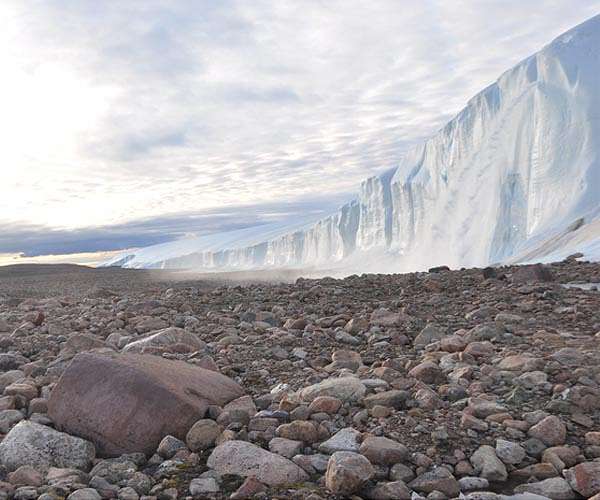
Greenland's inhospitable polar environment and barely-there infrastructure are among the hurdles facing mining companies.
There is, for example, no smelter to convert minerals into metals.
Greenland's soil and natural resources are, however, extremely well-mapped.
- Trump effect -
Olafsson said US President Donald Trump's outspoken desire to take control of Greenland and its natural resources had revived Denmark's own interest.
"There's a lot more interest on both sides of the Atlantic, both from Denmark, the EU and the US, which is great and has been helpful for us," said Olafsson, whose company has been present in Greenland since 2017.
In 2019, the United States signed a memorandum of understanding with Greenland on cooperation over mineral resources.
The European Union did the same four years later, identifying 25 of the 34 minerals on its official list of critical raw materials.
"Denmark is putting in place investments, it's putting in place various different means and much quicker than the US at the moment," said Olafsson, whose company is backed by Danish investors.
Greenland has managed its raw materials itself since obtaining self-rule in 2009.
Fisheries are the island's main source of revenue.
While the local government boasts of the island's mineral wealth, only two mines are currently active, including the Amaroq-operated Nalunaq gold mine, and production is limited.
Black Angel, a mine in northwestern Greenland that Amaroq plans to develop, could begin production in 2027 or 2028, thanks to infrastructure already in place from when it was an active mine in the 1940s and then again from 1973 to 1990.
Amaroq hopes to mine zinc, lead and silver there, as well as critical minerals such as germanium, gallium and cadmium.
"In 2027, 2028, Nalunaq will be one of the biggest taxpayers in Greenland," Olafsson said.
If Black Angel were to be of a similar scale, it could contribute to "Greenlanders' dream of seeing if mining could allow them to be economically independent" from Copenhagen.
One of the main challenges however is the workforce in the territory of 57,000 inhabitants.
Olafsson said 40 to 50 percent of workers on the Nalunaq site were Greenlanders.
"We import some skills that either don't exist and then have to train people... but over time, with more and more work going on in Greenland, there will be (a) need to import people," he said.
What are 'rare earths' for?
Paris (AFP) Dec 3, 2025 -
Crucial for making smartphones, fighter jets and electric cars, "rare earth" metals have become a strategic bargaining chip since main producer China this year introduced restrictions on their exports.
As the EU unveils a plan on Wednesday for boosting European production of critical raw materials to reduce reliance on China, here are some facts about these 17 elements and their key uses:
- Neodymium, praseodymium, dysprosium, terbium -
Global raw production of rare earths increased from 220,000 tonnes in 2019 to 390,000 tonnes in 2024 -- an increase of 77 percent over five years, according to a benchmark commodities report by French research group Cercle CyclOpe.
Four elements account for most of the sector's economic value: neodymium, praseodymium, dysprosium and terbium.
- Magnets for wind turbines -
These four "magnetic" rare earths are mainly used to make magnets, notably neodymium-iron-boron magnets -- about 10 times more powerful than conventional ones.
Use of the rare elements maximises magnets' performance while reducing size and weight, said Damien Ambroise, energy manager at French consultancy Bartle.
A single offshore wind turbine contains up to one tonne of such magnetic rare earths.
- Fighter jets, golf clubs -
Aviation is a major consumer of rare earths, especially for military plane manufacturing.
According to the US specialist newsletter Rare Earth Exchanges, US aerospace firm Lockheed Martin is the biggest American user of samarium, employed to make magnets that can withstand extremely high temperatures.
Each F-35 fighter jet requires more than 400 kilograms of rare earths, according to a report by the US Congressional Research Service.
Scandium is used to make light, strong aluminium-based alloys prized in aerospace -- and also in high-end sports gear such as golf clubs, bicycles and baseball bats.
- Smartphones -
Rare earths are also found in every smartphone, enhancing screen performance and enabling the phone to vibrate.
Each handset contains about three grams of them -- more than 3,700 tonnes overall for the 1.24 billion devices sold worldwide in 2024.
- Electric and fuel vehicles -
Each hybrid or electric vehicle battery and motor contains between 1.2 and 3.5 kilograms of rare earths, according to an estimate by France's Bureau of Geological and Mining Research.
They are also used in the manufacture of miniature motors, such as those that fold away a car's wing mirrors automatically when it is parked.
Combustion-engine vehicles use rare earths too, notably in catalytic converters. Lanthanum and cerium help cut fine particle emissions.
- Oil, glass, lasers -
In the chemical industry, cerium is widely used in oil refining and glass polishing -- as well as in flints for cigarette lighters.
Erbium is used in various medical fields, including dentistry, dermatology and ophthalmology.
Erbium and neodymium are also important in making lasers for industrial engraving and cutting.
Adding different rare earths alters the wavelength of the laser, and thus its use and colour, Ambroise said. "It makes for pretty colours in sound-and-light shows."
Related Links
Space Technology News - Applications and Research
| Subscribe Free To Our Daily Newsletters |

| Subscribe Free To Our Daily Newsletters |







