| . |  |
. |
| . | |
. |


Profile of Sea Shepherd environmental group
Sydney (AFP) Jan 17, 2008 The Sea Shepherd Conservation Society, engaged in a standoff with Japanese whalers in the Antarctic, is a small but militant environmentalist group specialising in "direct action." In the past that has included ramming a Japanese whaling vessel, while the current confrontation off the Antarctic erupted when two of its activists boarded a Japanese vessel. With a mandate to protect marine wildlife, but particularly mammals like whales and seals, the group has sent a ship to the Southern Ocean in four of the last five years to try to stop the Japanese whaling fleet. Its founder, Paul Watson, incorporated Sea Shepherd in the US state of Oregon in 1981, but its history goes back to 1977, when he founded a similar organisation in Vancouver, Canada, named Earth Force Society. The Canadian-born activist has been accused of using violent tactics in his conservation efforts, but said he had never injured anybody. "When people call us pirates I don't really have a problem with that -- we're pirates of compassion in pursuit of pirates of profit," he told AFP in an interview last year. According to international director Jonny Vasic, Sea Shepherd now has 40,000 supporters worldwide, of whom 12,000 could be considered active members, and an international staff of 10. It operates on an annual budget of around two million US dollars and claims Hollywood stars such as Martin Sheen, Pierce Brosnan and Sean Penn among its supporters, along with rock band Red Hot Chilli Peppers, he said. "We are much, much smaller," said Vasic, explaining how Sea Shepherd differed from other organisations. "Nearly 90 percent of our money goes on our direct action campaigns. "We are not a lobby group. We are not a petitioning movement. "What we are really good at is going to the point of impact, the point where the ocean wildlife is being killed or an ecosystem is being destroyed, and stopping that happening." The white haired Watson, pictured on the Sea Shepherd website (www.seashepherd.org) in captain's regalia, is a Canadian from the maritime province of New Brunswick. Now 57, he worked for the Canadian coastguard before a career as a merchant sailor took him around the world, according to his biography on the Sea Shepherd website. Later he was a founding member of Greenpeace. Sea Shepherd's head office is in Friday Harbor, in the US state of Washington. It has two operational ships. The 53-metre Steve Irwin, registered in the Netherlands and recently renamed in honour of Australia's late television "crocodile hunter", is a former Scottish Fisheries Protection Service vessel which is currently tailing the Japanese fleet in the Southern Ocean with a crew of 34. The other ship, the Farley Mowat, is a former Norwegian Fisheries research vessel currently stationed in Bermuda. A third ship, the former US coast guard vessel Yoshka, is on permanent loan to the government of the Galapagos islands where it patrols a marine national park. Community Email This Article Comment On This Article Related Links Follow the Whaling Debate
 We won't stop, activists tell Japanese whalers
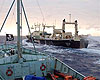 Sydney (AFP) Jan 16, 2008
A militant anti-whaling group chasing Japanese whalers refused Wednesday to abandon their high-seas harassment in return for the release of two of its activists detained on board one of the ships. |
|
|

| The content herein, unless otherwise known to be public domain, are Copyright 1995-2007 - SpaceDaily.AFP and UPI Wire Stories are copyright Agence France-Presse and United Press International. ESA Portal Reports are copyright European Space Agency. All NASA sourced material is public domain. Additional copyrights may apply in whole or part to other bona fide parties. Advertising does not imply endorsement,agreement or approval of any opinions, statements or information provided by SpaceDaily on any Web page published or hosted by SpaceDaily. Privacy Statement |