| . |  |
. |
| . | |
. |


Priming The Human Primate
Boston MA (SPX) Feb 22, 2005 Researchers have learned that despite the 99 percent similarity between the DNA of humans and our closest relative, the chimpanzee, a significant difference occurs in the places along the genome where gene swapping occurs. In the Feb. 10 online issue of the journal Science, researchers from the Broad Institute of MIT and Harvard report with colleagues that the locations of DNA swapping between chromosomes, known as recombination "hotspots," are nearly entirely different. "We started trying to compare recombination in humans and chimpanzees a couple of years ago, in the hope that better understanding this fundamental mechanism might inform our approach to mapping genes for human diseases, but our progress was stymied because identifying hotspots was laborious and inefficient," said co-senior author Dr. David Altshuler, director of the Broad's program in Medical and Population Genetics and associate professor of genetics and of medicine at Massachusetts General Hospital and Harvard Medical School. Recombination--or the swapping of genes between chromosomes--shapes the patterns of genetic variation in a species. It is the process in which DNA from an individual's father and mother is reshuffled to create new combinations of genes in the child--new combinations on which natural selection can act to shape the evolution of the species. Scientists recently discovered that recombination does not occur at random across the human genome, but is localized to particular places in the genome called hotspots. Because these hotspots are important to the study of genetic disease, the research team set out to compare recombination in the genomes of humans and chimpanzees. They expected the patterns to be very similar between the species, and that by comparing the DNA it would be possible to identify particular DNA sequences that might explain the localization of recombination to hotpots. The research team analyzed data collected in Boston using the methods developed in Oxford that make it possible to survey recombination at a genomic scale. They identified 18 hotspots in humans and three hotspots in chimps. To their surprise, none of the hotspots occurred in the same locations in human and chimp. "The surprising conclusion seems to be that there is probably something other than the DNA sequence, or perhaps in addition to it, that is determining where these hotspots are located," said Altshuler. "Epigenetic factors--biological codes that are layered on top of the DNA--may turn out to be more different in closely related species than the DNA sequence itself." Related Links Broad Institute SpaceDaily Search SpaceDaily Subscribe To SpaceDaily Express
 Fossils Push Human Emergence Back To 195,000 Years Ago
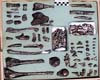 Salt Lake City UT (SPX) Feb 17, 2005
When the bones of two early humans were found in 1967 near Kibish, Ethiopia, they were thought to be 130,000 years old. A few years ago, researchers found 154,000- to 160,000-year-old human bones at Herto, Ethiopia. |
|
|

| The content herein, unless otherwise known to be public domain, are Copyright 1995-2006 - SpaceDaily.AFP and UPI Wire Stories are copyright Agence France-Presse and United Press International. ESA PortalReports are copyright European Space Agency. All NASA sourced material is public domain. Additionalcopyrights may apply in whole or part to other bona fide parties. Advertising does not imply endorsement,agreement or approval of any opinions, statements or information provided by SpaceDaily on any Web page published or hosted by SpaceDaily. Privacy Statement |