| . |  |
. |
| . | |
. |


 by Staff Writers Paris (ESA) Sep 22, 2020
Monitoring the cryosphere is essential to fully assess, predict and adapt to climate variability and change. Given the importance of this fragile component of the Earth system, ESA, along with Airbus Defence and Space and Thales Alenia Space, have signed a contract to develop the Copernicus Polar Ice and Snow Topography Altimeter mission, known as CRISTAL. With a launch planned in 2027, the CRISTAL mission will carry, for the first time on a polar mission, a dual-frequency radar altimeter, and microwave radiometer, that will measure and monitor sea-ice thickness, overlying snow depth and ice-sheet elevations. These data will support maritime operations in the polar oceans and contribute to a better understanding of climate processes. CRISTAL will also support applications related to coastal and inland waters, as well as providing observations of ocean topography. The mission will ensure the long-term continuation of radar altimetry ice elevation and topographic change records, following on from previous missions such as ESA's Earth Explorer CryoSat mission and other heritage missions. With a contract secured worth 300 euro million, Airbus Defence and Space has been selected to develop and build the new CRISTAL mission, while Thales Alenia Space has been chosen as the prime contractor to develop its Interferometric Radar Altimeter for Ice and Snow (IRIS). ESA's Director of Earth Observation Programmes, Josef Aschbacher, says, "I am extremely pleased to have the contract signed so we can continue the development of this crucial mission. It will be critical in monitoring climate indicators, including the variability of Arctic sea ice, and ice sheet and ice cap melting." The contract for CRISTAL is the second out of the six new high-priority candidate missions to be signed - after the Copernicus Carbon Dioxide Monitoring mission (CO2M) in late-July. The CRISTAL mission is part of the expansion of the Copernicus Space Component programme of ESA, in partnership with the European Commission. The European Copernicus flagship programme provides Earth observation and in situ data, as well as a broad range of services for environmental monitoring and protection, climate monitoring and natural disaster assessment to improve the quality of life of European citizens.
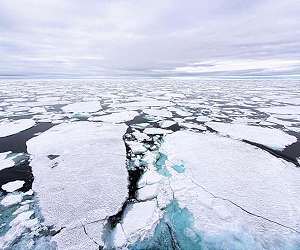
Sea ice triggered the Little Ice Age, finds a new study Boulder CO (SPX) Sep 18, 2020 A new study finds a trigger for the Little Ice Age that cooled Europe from the 1300s through mid-1800s, and supports surprising model results suggesting that under the right conditions sudden climate changes can occur spontaneously, without external forcing. The study, published in Science Advances, reports a comprehensive reconstruction of sea ice transported from the Arctic Ocean through the Fram Strait, by Greenland, and into the North Atlantic Ocean over the last 1400 years. The reconstruction ... read more
|
|||||||||||||
| The content herein, unless otherwise known to be public domain, are Copyright 1995-2026 - SpaceDaily. All websites are published in Australia and are solely subject to Australian law and governed by Fair Use principals for news reporting and research purposes. By using our websites you consent to cookie based advertising. If you do not agree with this then you must stop using the websites from May 25, 2018. Privacy Statement. Additional information can be found here at About Us. |

 del.icio.us
 Digg
Digg Reddit
 Google







