| . |  |
. |
| . | |
. |


Outside View: Syria must be involved
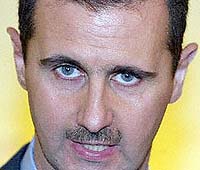
Moscow (UPI) Dec 22, 2006 The U.S. State Department has reminded the world that Syria was forced into international isolation for its ties with Iran and for supporting terrorism. But the Moscow visit of Syrian President Bashar al-Assad belies this statement. "Syria has always played a crucial role in the (Middle Eastern) region," Russian President Vladimir Putin said when opening the Kremlin talks with his Syrian counterpart. Assad came to Russia at a time of internal political turmoil in Lebanon and the Palestinian territories, and Washington's attempts to revise its policy in Iraq and the Middle East. Putin and Assad discussed all of these developments, with bilateral cooperation as the background for discussions of regional matters. Putin opened the talks by saying that he had exchanged opinions on the situation in the region with the Israeli and Lebanese prime ministers, as well as with other leaders in the region and outside it. The Untied States, France and Israel have accused Syria of interfering in Lebanon and the Palestinian territories, and of hampering stabilization by supporting extremist movements Hizbollah and Hamas. Russia was expected to ameliorate Syria's policy. The Kremlin leaders have expressed their opinion about the regional events, but in the form of recommendations, Assad said. They did not attempt to pressurize Syria, but proposed looking for solutions suiting all sides. Assad also said a stabilization mechanism for the Middle East was discussed at the Kremlin talks. He did not go into details, but everything he said before coming to Moscow and in the Kremlin boils down to recognizing the opinion of regional forces in the international effort to settle Middle East conflicts. Russia shares this view. Assad said at a news conference after his talks with Putin that they agreed on ways to resolve the Palestinian problem. Both presidents believe that the immediate task is to restore unity among Palestinians before discussing a peace settlement with Israel. This statement amounts to a tacit reproach directed at Israeli and American politicians who are trying to isolate Hamas and are talking only with the head of the Palestinian National Authority, Mahmoud Abbas. This also applies to the situation in Lebanon and Iraq. Assad said that Syria supports all consensus decisions on Lebanon, as well as efforts aimed at attaining national reconciliation in Iraq. The talks in Moscow focused on the Palestinian problem, Lebanon and Iraq, but only mentioned in passing Assad's statement on his country's readiness for peace talks with Israel, which had caused such an outcry in the press. Assad said in Moscow that he had only reaffirmed the stance Syria assumed in 1974. He added, however, that talks with Israel are out of the question at present, an opinion Tel Aviv accepts. According to RIA Novosti sources, Israel is also scrutinizing the Palestinian aspect of the problem and is concerned over the situation in Lebanon, whereas talks with Syria are at the bottom of its agenda. The only thing that worries Tel Aviv in relations with Damascus is the latter's role in the Lebanese and Palestinian conflicts. However, even Israel admits that Syria should be convinced rather than forced to change its stance. While rejecting direct dialogue with Syria, Israel does not object to other countries, including Russia, discussing acute regional problems with Damascus. The importance of dialogue with Syria is increasingly often recognized in Europe and the United States. Although President George W. Bush may not be prepared for this, his senators are doing their best to revive dialogue with Syria, and are negotiating with Assad. This cannot be described as international isolation. Syria's stance can seem unacceptable and irritating to some, but Assad is absolutely correct in saying that an attempt to force Syria into international isolation blocks the solution of Middle East problems. Moscow has always believed this, and the world is gradually accepting its view. (Marianna Belenkaya is a political commentator at RIA Novosti. This article was reprinted with permission from the news agency.) (United Press International`s 'Outside View' commentaries are written by outside contributors who specialize in a variety of important issues. The views expressed do not necessarily reflect those of United Press International. In the interests of creating an open forum, original submissions are invited.) Related Links Iraq: The first techonology war of the 21st century
 Outside View: Short-changing Iraq
 Washington (UPI) Dec 18, 2006
 President John F. Kennedy, speaking to the graduating class of the U.S. Naval Academy on June 7, 1961, stressed the importance for military professionals to understand the use of four elements of national power: diplomacy, information, military and economic, or DIME. |
|
|

| The content herein, unless otherwise known to be public domain, are Copyright 1995-2006 - SpaceDaily.AFP and UPI Wire Stories are copyright Agence France-Presse and United Press International. ESA PortalReports are copyright European Space Agency. All NASA sourced material is public domain. Additionalcopyrights may apply in whole or part to other bona fide parties. Advertising does not imply endorsement,agreement or approval of any opinions, statements or information provided by SpaceDaily on any Web page published or hosted by SpaceDaily. Privacy Statement |