|
 |
 |
 |
 |
 |
 |
 |
 |
 |

| . |  |
. |
Not Long Ago, In A Galaxy Far Away...
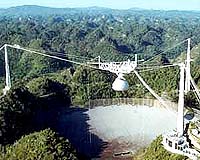
Arecibo, Puerto Rico (SPX) Sep 03, 2004 In February 2003, astronomers involved in the search for extraterrestrial intelligence (SETI) pointed the massive radio telescope in Arecibo, Puerto Rico, at around 200 sections of the sky. The same telescope had previously detected unexplained radio signals at least twice from each of these regions, and the astronomers were trying to reconfirm the findings, writes New Scientist. The team has now finished analysing the data, and all the signals seem to have disappeared. Except one, which has got stronger. This radio signal, now seen on three separate occasions, is an enigma. It could be generated by a previously unknown astronomical phenomenon. Or it could be something much more mundane, maybe an artefact of the telescope itself. But it also happens to be the best candidate yet for a contact by intelligent aliens in the nearly six-year history of the SETI@home project, which uses programs running as screensavers on millions of personal computers worldwide to sift through signals picked up by the Arecibo telescope, the weekly UK science magazine New Scientist. "It's the most interesting signal from SETI@home," says Dan Wertheimer, a radio astronomer at the University of California, Berkeley (UCB) and the chief scientist for SETI@home. "We're not jumping up and down, but we are continuing to observe it." Named SHGb02+14a, the signal has a frequency of about 1420 megahertz. This happens to be one of the main frequencies at which hydrogen, the most common element in the universe, readily absorbs and emits energy. Some astronomers have argued that extraterrestrials trying to advertise their presence would be likely to transmit at this frequency, and SETI researchers conventionally scan this part of the radio spectrum. SHGb02+14a seems to be coming from a point between the constellations Pisces and Aries where there is no obvious star or planetary system within 1000 light years. And the transmission is very weak. "We are looking for something that screams out 'artificial'," says UCB researcher Eric Korpela, who completed the analysis of the signal in April. "This just doesn't do that, but it could be because it is distant." The telescope has only observed the signal for about a minute in total, which is not long enough for astronomers to analyse it thoroughly. But, Korpela thinks it unlikely SHGb02+14a is the result of any obvious radio interference or noise, and it does not bear the signature of any known astronomical object. That doesn't mean that only aliens could have produced it. "It may be a natural phenomenon of a previously undreamed-of kind like I stumbled over," says Jocelyn Bell Burnell of the University of Bath, UK. It was Bell Burnell who in 1967 noticed a pulsed radio signal which the research team at the time thought was from extraterrestrials but which turned out to be the first ever sighting of a pulsar. There are other oddities. For instance, the signal's frequency is drifting by between 8 to 37 hertz per second. "The signal is moving rapidly in frequency and you would expect that to happen if you are looking at a transmitter on a planet that's rotating very rapidly and where the civilisation is not correcting the transmission for the motion of the planet," Korpela says. This does not, however, convince Paul Horowitz, a Harvard University astronomer who looks for alien signals using optical telescopes. He points out that the SETI@home software corrects for any drift in frequency. The fact that the signal continues to drift after this correction is "fishy", he says. "If [the aliens] are so smart, they'll adjust their signal for their planet's motion." This article is based upon an article that will appear in the September 4 edition of New Scientist. Related Links UC Berkeley SETI Institute SpaceDaily Search SpaceDaily Subscribe To SpaceDaily Express
 Scientists Discover First Of A New Class Of Extrasolar Planets
 Berkeley CA (SPX) Sep 01, 2004
Astronomers announced today the first discovery of a new class of planets beyond our solar system about 10 to 20 times the size of Earth - far smaller than any previously detected. The planets make up a new class of Neptune-sized extrasolar planets.
--------------------------------------------------------- It's new. And it's downright terrific! Celestron's CPC Schmidt-Cassegrain telescope is the scope you've been waiting for! It offers new alignment technology, advanced engineering, and bold new design at a new, low price! In fact, Celestron's Professional Computerized (CPC) scope with revolutionary SkyAlign Alignment Technology redefines everything that amateur astronomers are looking for. It offers quick and simple alignment, GPS technology, unsurpassed optical quality, ease of use, advanced ergonomics, enhanced computerization and, most important, affordability. Want to view M-31 tonight? One button takes you there!
Shop for telescopes online at Telescopes.com! today!
|
|
|

| The content herein, unless otherwise known to be public domain, are Copyright 1995-2006 - SpaceDaily.AFP and UPI Wire Stories are copyright Agence France-Presse and United Press International. ESA PortalReports are copyright European Space Agency. All NASA sourced material is public domain. Additionalcopyrights may apply in whole or part to other bona fide parties. Advertising does not imply endorsement,agreement or approval of any opinions, statements or information provided by SpaceDaily on any Web page published or hosted by SpaceDaily. Privacy Statement |