| . |  |
. |
| . | |
. |


New US Image Czar Must Play Modern Media PR Game
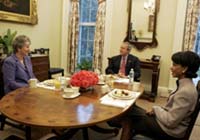
Washington (AFP) Jul 26, 2005 Karen Hughes, President George W. Bush's political sidekick, is gearing up for one of the toughest assignments of her hard-hitting career -- repairing the soiled US reputation in the Islamic world. Hughes, who helped fashion Bush's image as a down-home political gunslinger, won unanimous backing Tuesday from the Senate Foreign Relations committee -- and could get the nod from the full Senate later this week. She faces a tough task, experts say, and Hughes herself has admitted the need to retool the US image machine, to cope with the new warp speed media climate fostered by the information revolution. In the new era of 24-hour satellite television stations and Internet bloggers, an inaccurate rumor can quickly morph into conventional wisdom -- a fact the lumbering US diplomatic machinery is poorly suited to combat. "During the Cold war, we were trying to get information into largely closed societies whose people were hungry for that knowledge," Hughes said in her confirmation hearing last week. "Today we are more often competing for attention and credibility in the midst of an information explosion," said Hughes, Bush's nominee for under secretary of state for public diplomacy. What Washington needs most is a nimble media operation which can swing into action fast to combat unflattering information, say experts who have studied the US image in the Muslim world. "If you don't swat it down quickly, it becomes information" detrimental to the perception of the United States, said Dr Craig Charney, president of a political research firm which has studied the US reputation throughout the Muslim world. Every few years, it seems, top US officials demand a new "public diplomacy" crusade, frustrated that much of the rest of the world fails to see what Hughes referred to last week as America's "goodness and decency." There is much debate whether US policies are to blame for Washington's image problems, for instance strong support of Israel, or whether the American government is just failing to get its "message across." US image makers already had a tough job on their hands, battling negative perceptions of the US invasion of Iraq, and the image problems fostered by the "war on terror" camp at Guantanamo Bay, Cuba, for instance. Opinion surveys frequently find suspicion of America running high, especially in Muslim majority nations. In a survey released last month by the Pew Research Center, 38 percent of Indonesians, 23 percent of Turks, 23 percent of Pakistanis and 21 percent of Jordanians surveyed had a favourable opinion of the United States. "It is clear that what we are talking about here is a major failure of public diplomacy," said Charney at a forum Tuesday on public diplomacy at the Center for American Progress think-tank. "In the information war, the United States has unilaterally disarmed." Charney discovered in focus group research conducted for the Council on Foreign Relations in May that although Muslims are often angry at America's actions, a better attempt to communicate can improve the US image. He found that Arabic satellite networks such as al-Jazeera, which he said was marked by "constant critical coverage" of US policy, drove the tone of Arab media coverage of the US. And he said that perceptions of the United States were enhanced by Washington's help to Muslims after the tsunami tragedy in Asia late last year, the Iraq elections and hopes for political change in Lebanon and Egypt. Senator Dick Lugar, chairman of the Senate Foreign Relations Committee, warned Hughes last week that US citizens were "troubled by examples of virulent anti-American hatred in the Islamic world." "Numerous reports have concluded that American public diplomacy is dysfunctional and requires major reform," he said. Mike McCurry, a former White House and State Department spokesman, said that as well as problems abroad, US leaders faced funding headaches and struggled to convince Americans that public diplomacy was worthwhile. "The problem is a lot of Americans probably sit back and say, Well I don't care what the Muslim world thinks about us, as long as they don't try and kill us." Related Links SpaceDaily Search SpaceDaily Subscribe To SpaceDaily Express
 Experts Warn Of Chinese Cyberattacks Used For Industrial Secrets
 Washington (AFP) Jul 24, 2005
Cyberspace is becoming a new battleground for the United States and China, amid growing concerns about Chinese industrial espionage through various types of computer worms, security experts say. |
|
|

| The content herein, unless otherwise known to be public domain, are Copyright 1995-2006 - SpaceDaily.AFP and UPI Wire Stories are copyright Agence France-Presse and United Press International. ESA PortalReports are copyright European Space Agency. All NASA sourced material is public domain. Additionalcopyrights may apply in whole or part to other bona fide parties. Advertising does not imply endorsement,agreement or approval of any opinions, statements or information provided by SpaceDaily on any Web page published or hosted by SpaceDaily. Privacy Statement |