| . |  |
. |
| . | |
. |


New Techniques Study The Brain's Chemistry, Neuron By Neuron
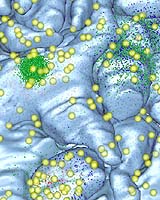
Champaign IL (SPX) Sep 01, 2005 The human brain is composed of billions of cells, each a separate entity that communicates with others. The chemical interaction of those cells determines personality, controls behavior and encodes memory; but much remains to be understood. Researchers at the University of Illinois at Urbana-Champaign have developed tools for studying the chemistry of the brain, neuron by neuron. The analytical techniques can probe the spatial and temporal distribution of biologically important molecules, such as vitamin E, and explore the chemical messengers behind thought, memory and emotion. "In most organ tissues of the body, adjacent cells do not have significant differences in their chemical contents," said Jonathan Sweedler, a William H. and Janet Lycan Professor of Chemistry and director of the Biotechnology Center at the U. of I. "In the brain, however, chemical differences between neurons are critical for their operation, and the connections between cells are crucial for encoding information or controlling functions." By dismantling a slice of brain tissue into millions of single cell-size pieces, each of which can be interrogated by mass spectrometric imaging techniques, Sweedler's research group can perform cellular profiling, examine intercellular signaling, map the distribution of new neuropeptides, and follow the release of chemicals in an activity-dependent manner. Sweedler will describe the techniques and present new results at the 230th American Chemical Society national meeting in Washington, D.C. Using these techniques, Sweedler's group has already discovered multiple novel neuropeptides in a range of neuronal models from mollusks to mammals. "We work with sea slugs, whose simple brains contain 10,000 neurons; we work with insects possessing one million neurons; and we work with mice having 100 million neurons," said Sweedler, who also is a researcher at the Beckman Institute for Advanced Science and Technology. "Working with these model organisms allows us to examine the functioning of such basic operations as the neuronal control of behavior and long-term memory." Sweedler's group also developed an approach for looking at the distribution of smaller molecules in brain cells. In a paper accepted for publication in the Journal of the American Chemical Society, and posted on its Web site, they report the subcellular imaging of vitamin E in the sea slug Aplysia californica. The researchers utilized novel sampling protocols and single cell time-of-flight secondary ion mass spectrometry to identify and map the presence of vitamin E in the membranes of isolated neurons. "To our surprise, we found that vitamin E was not distributed uniformly in the neuronal membrane," Sweedler said. "Instead, vitamin E was concentrated in the neuron right where it extends to connect with other neurons." The subcellular localization of vitamin E, which had been impossible to obtain in the past, supports other work that suggested vitamin E performed an active role in transport mechanisms and cellular signaling of neurons. "Our technique doesn't tell us how or why vitamin E is distributed this way, but suggests that it is under active control and tight regulation," Sweedler said. "Understanding the chemistry that takes place within and between neurons, including small molecules like vitamin E, will no doubt lead to a better understanding of brain function in healthy and diseased brains." Co-authors of the paper are Sweedler, research scientists Jinju Lee and Stanislav Rubakhin, postdoctoral research associate John Jurchen and graduate student Eric Monroe. The U.S. Department of Energy and the National Institute on Drug Abuse funded the work. Related Links SpaceDaily Search SpaceDaily Subscribe To SpaceDaily Express
 Parts Of Brain Battle Over Decisions
 Stanford, Calif. (UPI) Sep 01, 2005
Researchers have identified areas in the brain that anticipate joy and fear and say they battle it out when a big decision is to be made. |
|
|

| The content herein, unless otherwise known to be public domain, are Copyright 1995-2006 - SpaceDaily.AFP and UPI Wire Stories are copyright Agence France-Presse and United Press International. ESA PortalReports are copyright European Space Agency. All NASA sourced material is public domain. Additionalcopyrights may apply in whole or part to other bona fide parties. Advertising does not imply endorsement,agreement or approval of any opinions, statements or information provided by SpaceDaily on any Web page published or hosted by SpaceDaily. Privacy Statement |