|
 |
 |
 |
 |
 |
 |
 |
 |
 |

| . |  |
. |
New Melting Moment
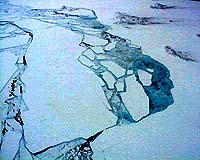
Washington (AFP) Aug 04, 2005 The collapse of a huge ice shelf in Antarctica in 2002 has no precedent in the past 11,000 years, according to a study that points the finger at global warming. Measuring some 3,250 sq km in area and 220m thick, the Larsen B iceshelf broke away from the eastern Antarctic Peninsula in 2002, eventually disintegrating into giant icebergs. By chance, a US-led team of geologists had gathered a rich harvest of data around the iceshelf just before the spectacular collapse, including six cores that had been drilled into marine sediment. The cores contain the remains of plankton and algae imbedded in layers of minerals, and their radiocarbon and oxygen isotopes provide clues about ice cover and climate change over the millennia. The researchers, reporting in Nature, the British science weekly, say that since the end of the last Ice Age, some 11,000 years ago, the iceshelf had been intact but had slowly thinned, by several dozen metres. Its coup de grace came from a recent but decades-long rise in air temperature, they say. "The modern collapse of the LIS-B [Larsen B iceshelf] is a unique event within the Holocene," they write. "The LIS-B eventually thinned to the point where it succumbed to the prolonged period of regional warming now affecting the entire Antarctic Peninsula region." The Holocene is the period of relatively balmy weather that followed the last Ice Age. The research is the latest in a series of studies to sound the alarm about the effects of climate change in Antarctica, where the bulk of the world's freshwater is locked up. The Antarctic Peninsula, which juts northwards out of West Antarctica, is considered a warming hot-spot. Over the past half century, temperatures in the peninsula have risen by around two degrees Celsius. In recent years, the peninsula has lost ice shelves totalling more than 12,500 sq km, equivalent to four times the area of Luxembourg. Of the 244 glaciers that drain inland ice and feed these shelves, 87 per cent have fallen back since the mid-1950s, according to a British study published in April. Global warming, also called the greenhouse effect, is caused by carbon gases mostly discharged by burning oil, gas and coal, that trap the Sun's heat. But Earth's climate also goes through natural oscillations of warming and cooling, resulting in Ice Ages and the milder interglacial periods in between. The new study does not say that global warming caused by human activity was responsible for the Larsen B's demise. However, it refers to a steep rise in the temperatures over the past several decades, a phenomenon that climatologists concur was unleashed by fossil fuels. Related Links SpaceDaily Search SpaceDaily Subscribe To SpaceDaily Express
 Evolutionary Accident Probably Caused The Worst Snowball Earth Episode
 Pasadena CA (SPX) Aug 02, 2005
For several years geologists have been gathering evidence indicating that Earth has gone into a deep freeze on several occasions, with ice covering even the equator and with potentially devastating consequences for life. The theory, known as "Snowball Earth," has been lacking a good explanation for what triggered the global glaciations. |
|
|

| The content herein, unless otherwise known to be public domain, are Copyright 1995-2006 - SpaceDaily.AFP and UPI Wire Stories are copyright Agence France-Presse and United Press International. ESA PortalReports are copyright European Space Agency. All NASA sourced material is public domain. Additionalcopyrights may apply in whole or part to other bona fide parties. Advertising does not imply endorsement,agreement or approval of any opinions, statements or information provided by SpaceDaily on any Web page published or hosted by SpaceDaily. Privacy Statement |