| . |  |
. |
| . | |
. |


New Indian Anti-Hijack Policy Allows Shooting-Down Of Rogue Planes
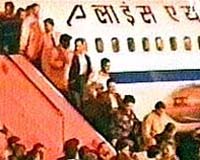
New Delhi (AFP) Aug 14, 2005 India has finalised a policy to deal with the hijacking of airliners that rules out negotiations with hijackers and allows the shooting down of aircraft deemed to have been turned into "missiles", media reported Sunday. The policy, approved by the security cabinet last week, states that any attempt to hijack an aircraft will be deemed an act of aggression against the country and prompt a response "fit for an aggressor", the Indian Express said. According to the policy, an airborne hijacked aircraft will be escorted by air force fighter jets at all times when it is within Indian airspace. If an Indian-registered aircraft is hijacked, the strategy will be to get it to land at an Indian airport. Once on the ground, airport personnel will take steps to ensure it does not take off again. The issue of plane hijackings is a sensitive one in India. Almost six years ago India freed three jailed Islamic militants in exchange for more than 150 passengers and crew when an Indian Airlines plane was hijacked by five gunmen and flown to Kandahar in Afghanistan. One of the freed men, British-born Ahmed Omar Saeed Sheikh, had been arrested by Indian police in 1994 for his alleged involvement in the kidnapping of three Britons and an American in India. Sheikh was also implicated in the 2002 kidnap and murder of Wall Street Journal journalist, American Daniel Pearl, in Pakistan. Another of the men exchanged for the hostages was Maulana Masood Azhar, who months after his release formed the Jaish-e-Mohammad militant group. It is accused of triggering a string of deadly attacks on Indian targets, including one on parliament in Delhi in December 2001. India's new policy comes almost four years after the World Trade Centre and Pentagon attacks of September 11, 2001 in which hijacked planes were used as missiles. The new policy sets out guidelines to be followed before shooting a "threat aircraft", newspapers and television channels reported, quoting government sources. Before any action is taken the authorities have to determine beyond doubt that the hijacked aircraft will hit a strategic target. An aircraft will be deemed "doubtful" if it deviates from its allotted course, does not comply with air traffic control instructions and if its transponder does not respond. It is designated a "rogue aircraft" if it ignores advice of the ATC and continues to deviate from its designated flight path and does not respond to radio telephony. A "rogue aircraft" - which takes no cognisance of ATC warnings or that of air defence fighter jets and whose flight path is aligned to a strategic target like the presidential palace, government installations or parliament - will be shot down under the new policy. The decision to shoot down a plane will be taken by the security cabinet. But if there is not enough time, the prime minister, defence minister or home minister - whoever is contacted first - will make the decision. In extreme situations offering very little reaction time, the decision to shoot down a rogue aircraft will rest with the Indian Air Force, with a senior official giving instructions to bring the plane down. The policy caters for armed intervention to end a hijack, with the decision to storm an aircraft to be taken by the security cabinet. Related Links SpaceDaily Search SpaceDaily Subscribe To SpaceDaily Express
 Stressed Out Indian Techies Take Shelter In Spas, Meditation Centers
 Bangalore, India (AFP) Jul 18, 2005
Indian software engineer Mehul Patel, working with cellphone maker Kyocera, arrived back in Bangalore after hectic business trips to the United States and Europe in a "state of daze". |
|
|

| The content herein, unless otherwise known to be public domain, are Copyright 1995-2006 - SpaceDaily.AFP and UPI Wire Stories are copyright Agence France-Presse and United Press International. ESA PortalReports are copyright European Space Agency. All NASA sourced material is public domain. Additionalcopyrights may apply in whole or part to other bona fide parties. Advertising does not imply endorsement,agreement or approval of any opinions, statements or information provided by SpaceDaily on any Web page published or hosted by SpaceDaily. Privacy Statement |