| . |  |
. |
| . | |
. |


 by Staff Writers Laurel MD (SPX) Jan 03, 2019
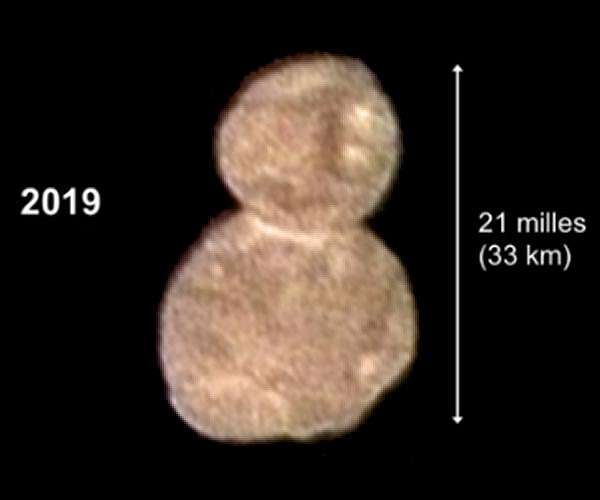
Scientists from NASA's New Horizons mission released the first detailed images of the most distant object ever explored - the Kuiper Belt object nicknamed Ultima Thule. Its remarkable appearance, unlike anything we've seen before, illuminates the processes that built the planets four and a half billion years ago. "This flyby is a historic achievement," said New Horizons principal investigator Alan Stern of the Southwest Research Institute in Boulder, Colorado. "Never before has any spacecraft team tracked down such a small body at such high speed so far away in the abyss of space. New Horizons has set a new bar for state-of-the-art spacecraft navigation." The new images - taken from as close as 17,000 miles (27,000 kilometers) on approach - revealed Ultima Thule as a "contact binary," consisting of two connected spheres. End to end, the world measures 19 miles (31 kilometers) in length. The team has dubbed the larger sphere "Ultima" (12 miles/19 kilometers across) and the smaller sphere "Thule" (9 miles/14 kilometers across). The team says that the two spheres likely joined as early as 99 percent of the way back to the formation of the solar system, colliding no faster than two cars in a fender-bender. "New Horizons is like a time machine, taking us back to the birth of the solar system. We are seeing a physical representation of the beginning of planetary formation, frozen in time," said Jeff Moore, New Horizons Geology and Geophysics team lead. "Studying Ultima Thule is helping us understand how planets form - both those in our own solar system and those orbiting other stars in our galaxy." Data from the New Year's Day flyby will continue to arrive over the next weeks and months, with much higher resolution images yet to come. "In the coming months, New Horizons will transmit dozens of data sets to Earth, and we'll write new chapters in the story of Ultima Thule - and the solar system," said Helene Winters, New Horizons project manager.
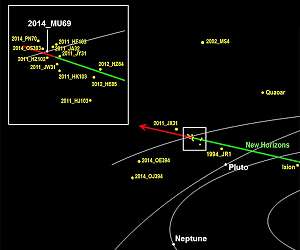
The PI's Perspective: Anticipation on Ultima's Doorstep Laurel MD (SPX) Dec 28, 2018 The New Horizons spacecraft is healthy and on final approach to the first close-up exploration of a Kuiper Belt object in history, and the farthest exploration of any world, ever. In just a few days, on New Year's Eve and New Year's Day, New Horizons will swoop three times closer to our target-2014 MU69 (nicknamed Ultima Thule)-than we flew past Pluto. The anticipation is palpable now: we are on the verge of an important scientific exploration almost 20 years in the making and, in many ways, unlik ... read more
|
|||||||||||||
| The content herein, unless otherwise known to be public domain, are Copyright 1995-2026 - SpaceDaily. All websites are published in Australia and are solely subject to Australian law and governed by Fair Use principals for news reporting and research purposes. By using our websites you consent to cookie based advertising. If you do not agree with this then you must stop using the websites from May 25, 2018. Privacy Statement. Additional information can be found here at About Us. |

 del.icio.us
 Digg
Digg Reddit
 Google






