| . |  |
. |
| . | |
. |


NKorea Nuclear Talks Reach Stalemate, Delegates Say
Beijing (AFP) Sep 15, 2005 Six-nation delegates trying to negotiate an end to North Korea's nuclear weapons drive said Thursday that the talks had reached a stalemate over Pyongyang's demand for the right to run atomic power stations. Representatives of North Korea, the United States, Japan and China all said the talks had ground to a halt three days after meetings resumed here following a five-week recess. "There wasn't any progress today ... We are in a bit of a standoff at the moment," US envoy Christopher Hill told reporters after a day of meetings with his North Korean counterpart and other chief delegates. Hill said there was a "major disagreement" between the US and Stalinist North Korea, a self-avowed nuclear power, echoing the assessments of host country China and Japan. But there was no sign the talks had broken down with the US and North Korea indicating they will continue discussions Friday. The dispute centres on the North's demand that the international community recognizes its right to operate nuclear programs for civilian use and help it build light-water reactors to generate electricity before it dismantles its atomic weapons program. The United States and Japan have refused, with the US saying that the cost and timeframe of building the reactors is impractical and that the energy-starved state cannot be trusted to confine a reactor to civilian use. "No country will transfer materials to a country which is not in the (nuclear) Non-Proliferation Treaty (NPT)," Hill said, referring to an accord Pyongyang withdrew from in 2003. "Unless they dismantle their existing programs, they will have no chance to get back into the NPT." Japan's top envoy Kenchiro Sasae agreed. "North Korea's demand for a light water reactor is strong. We are not in a position to accept it as it is. The prospect is bleak unless this question is resolved," Sasae said. In an attempt to work through their differences, Hill and his North Korean counterpart Kim Gye-gwan held a 90-minute one-on-one meeting Thursday but failed to reach a compromise, with one official saying both left the meeting with "stiff faces." A spokesman for North Korea's delegation agreed Thursday the talks were "not making progress" due to the dispute over light water reactors. "While other participating countries expressed understanding on this issue, the United States unreasonably vowed not to provide light water reactors," said spokesman Hyun Hak-bong. Hill, however, said no country was prepared to help the North build the reactors and urged the North to instead accept "a pretty good deal" on the table. "The deal consists of really a lot of what the DPRK (North Korea) should want: security guarantees, a recognition package, access to international financial institutions, a very serious energy package," Hill said. The fourth round of talks involving the two Koreas, Japan, Russia, China and the United States resumed on Tuesday. Hill said no deadline had been set to end the latest incarnation of a process which started more than two years ago. "Everybody has got an interest in solving this problem through diplomatic means ... There will be a point at which we look at the deadline, but we are not at that point yet," Hill said. The talks are aimed at persuading North Korea, which says it has nuclear weapons, to give them up verifiably and irreversibly in exchange for security guarantees as well as energy and economic aid. Differences also exist between the other parties. While the United States and Japan insisted that light-water reactors were out of the question, South Korea, anxious to improve relations with the North, said it should remain an option. China and Russia have also sided with North Korea on the nuclear energy issue, though not as vocally as Seoul. Hill said it would take up to a decade to build a light-water reactor and cost two to three billion dollars, urging the North instead to accept a South Korean offer to run power lines across the border. Under a now defunct 1994 agreement, two light-water reactors were to have been built by a US-led consortium to replace North Korea's existing graphite-moderated reactors which can produce weapons-grade plutonium. Light-water reactors produce less weapons-grade plutonium. But construction was suspended after the United States in 2002 accused the North of developing a secret uranium-enrichment program. Failure to reach agreement in Beijing could prompt the United States to take the issue to the UN Security Council and press for sanctions. Related Links SpaceDaily Search SpaceDaily Subscribe To SpaceDaily Express
 North Korea Talks Deadlocked On Light Water Reactor
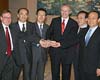 Beijing (UPI) Sep 15, 2005
The first full day of six party talks ended Wednesday with North Korea insisting on its right to nuclear energy and renewed demands for a light water reactor. |
|
|

| The content herein, unless otherwise known to be public domain, are Copyright 1995-2006 - SpaceDaily.AFP and UPI Wire Stories are copyright Agence France-Presse and United Press International. ESA PortalReports are copyright European Space Agency. All NASA sourced material is public domain. Additionalcopyrights may apply in whole or part to other bona fide parties. Advertising does not imply endorsement,agreement or approval of any opinions, statements or information provided by SpaceDaily on any Web page published or hosted by SpaceDaily. Privacy Statement |