| . |  |
. |
| . | |
. |


NASA Research To Aid Federal Invasive Species Council Efforts
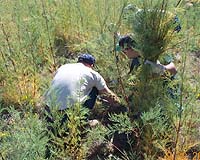
Needham Heights MA (SPX) Feb 03, 2005 NASA recently accepted an invitation to join the National Invasive Species Council (NISC). NASA, in a research capacity, will assist 12 other federal agencies' efforts to combat invasive species across the country. An invasive species is an organism, such as a microbe, plant or animal, which entered America through natural processes or with human assistance and whose presence poses a threat to public health or the economy. One example, Salt Cedar, is an invasive plant widespread in the western United States. It replaced native species and may have significant negative effects on water resources. "NASA is pleased with this invitation from NISC. The agency is eager to continue our active engagement in applied research projects whose results advance management of invasive species," said Edwin Sheffner, manager of the invasive species program element in the Applied Sciences Program at NASA Headquarters. "Efforts to manage invasive species annually cost the country tens of billions of dollars," he said. NASA will enhance partner's abilities to respond effectively and efficiently to invasive species' challenges. NASA provides Earth observations and predictive models resulting from space research and systems engineering expertise. NASA's track record of achievement in invasive species monitoring led to the invitation to join the Council. An example of NASA's impact is work completed by the U.S. Geological Survey (USGS) on invasive species in Utah's Grand Staircase-Escalante National Monument. The USGS improved the accuracy and timeliness of predictive maps of invasive species in the Monument with enhancements to decision support tools from NASA data, predictive models and systems engineering. Moderate Resolution Imaging Spectroradiometer (MODIS) data from NASA's Terra satellite provides daily information about vegetation conditions. Statistical models applied by USGS, with NASA's assistance, convert MODIS and other data sources into predictive maps of plant species distribution. The USGS is incorporating NASA's research capabilities to improve the national response to invasive species through the National Invasive Species Forecasting System (NISFS). The NISC coordinates federal responses to harmful invasive species. NISC is a cabinet level council established by Executive Order in 1999. The NISC provides leadership and ensures complementary, cost-efficient, effective federal activities regarding invasive species. NISC depends on cooperation from local, state, tribal, private and public partners to perform its mission. The NISC Web site is the gateway to federal efforts concerning invasive species. Users can learn about the impact of invasive species, and the government's response; read profiles about specific species; find links to agencies and organizations that handle invasive species issues. To access the NISC gateway on the Web, visit: Related Links Invasive Species SpaceDaily Search SpaceDaily Subscribe To SpaceDaily Express
 Please, Do Disturb
 Potsdam, Germany (SPX) Feb 01, 2005
Noise is usually nothing more than a disturbance, but sometimes it can be useful. Researchers have discovered that noise could bring order to chaotic systems, protect and maintain entire marine ecosystems, and even make the chemical industry greener. |
|
|

| The content herein, unless otherwise known to be public domain, are Copyright 1995-2006 - SpaceDaily.AFP and UPI Wire Stories are copyright Agence France-Presse and United Press International. ESA PortalReports are copyright European Space Agency. All NASA sourced material is public domain. Additionalcopyrights may apply in whole or part to other bona fide parties. Advertising does not imply endorsement,agreement or approval of any opinions, statements or information provided by SpaceDaily on any Web page published or hosted by SpaceDaily. Privacy Statement |