|
 |
 |
 |
 |
 |
 |
 |
 |
 |

| . |  |
. |
NASA Helps Find Lifelong Gene Activity In Live Organisms
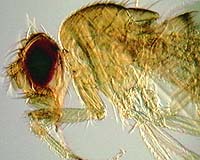
Moffett Field CA (SPX) Oct 25, 2004 NASA scientists and their academic colleagues are providing valuable insights into how DNA encodes instructions for control of basic biological functions. Their research may change the understanding of human diseases. Scientists at NASA's Ames Research Center, Moffett Field, Calif., worked in collaboration with scientists from Yale University, Columbia University, and the University of Amsterdam. They discovered genes that change during the development of a living organism at every major stage of its life cycle. The scientists produced a unique map of gene expression for the common fruit fly (Drosophila melanogaster), an organism widely used by researchers to study diseases. NASA uses the fruit fly to study the effects of microgravity and radiation on biological organisms. "Acquiring knowledge about the fruit fly is an important tool for understanding and dissecting human illness and biological processes," said Dr. Viktor Stolc, director of the Genome Research Facility at Ames. Using advanced technology, researchers were able to attach to specially patterned glass slides short pieces of DNA that recognize sequences in genes throughout the fruit fly's own DNA blueprint, called the genome. The slide arrays were used to measure levels of ribonucleic acid (RNA), biochemical copies of the DNA produced when genes are activated to make proteins. The study results, published today in the journal Science, provide an expression map for the entire non-repetitive genome, that reveals a much more extensive and diverse set of expressed RNA sequences than had been previously predicted or observed. The Science manuscript generated a complete record of all fly gene activities, which has never been done before. This information is the essential first-step in developing comprehensive understanding of gene responses to space flight. Better understanding of microgravity impact on human health and development will help NASA to ensure astronauts' wellbeing during long duration space flights exploring the moon and Mars. RNA levels were measured for every gene at each major stage of the fly's development, from egg to adult, in both males and females. The results provide a detailed picture of gene activity, including new information about currently uncharacterized parts of the fruit fly genome, according to Stolc. "As a result of this research, we now have a more comprehensive view of gene activity in the fly during development, which will impact future analyses of the complete set of genetic material in the cells of living organisms," he added. Related Links Phenomorph at Ames SpaceDaily Search SpaceDaily Subscribe To SpaceDaily Express
 How To Build A Planet
 Washington (UPI) Oct 21, 2004
The supreme irony about the currently peaceful, stable nature of the Earth - global conflicts and climate change notwithstanding - is that this harbor for life arose from violent, chaotic beginnings. |
|
|

| The content herein, unless otherwise known to be public domain, are Copyright 1995-2006 - SpaceDaily.AFP and UPI Wire Stories are copyright Agence France-Presse and United Press International. ESA PortalReports are copyright European Space Agency. All NASA sourced material is public domain. Additionalcopyrights may apply in whole or part to other bona fide parties. Advertising does not imply endorsement,agreement or approval of any opinions, statements or information provided by SpaceDaily on any Web page published or hosted by SpaceDaily. Privacy Statement |