| . |  |
. |
| . | |
. |


NASA Delays Latest Space Telescope Launch
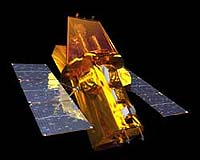
Washington DC (SPX) Nov 18, 2004 Launch of NASA's Swift spacecraft has been delayed at least 24 hours due to a concern with Range Command-Receiver Decoder equipment on the launch vehicle. The concern arose over night after the "Safe and Arm" devices were connected on the launch vehicle. The decision to postpone the launch, aboard a Boeing Delta II rocket, occurred as engineers were making final checks prior to launch tower roll back at complex 17 on Cape Canaveral Air Force Station, in Fla. The launch management team will meet later today to confirm a new date based on today's engineering assessments. Launch is expected no earlier than Thursday at 12:09 p.m. EST.
Los Alamos Software Key To New Swift Satellite Mission "Swift," a new NASA satellite, will head for the heavens Nov. 17, designed to detect gamma-ray bursts and whip around to catch them in the act. And the trigger software that makes the flying observatory smart enough to do this comes from the Space Science team at the Los Alamos National Laboratory. Gamma-ray bursts, first discovered by Los Alamos in the course of nuclear nonproliferation data analysis, occur randomly throughout the universe. They are the most powerful explosions known to mankind, exceeded only by the Big Bang. Swift's Burst Alert Telescope will detect and locate about two bursts a week and relay their positions to the ground in less than 15 seconds. By studying the bursts, scientists have the opportunity to illuminate some of the earliest mysteries of the universe. "We believe Swift is capable of observing gamma-ray bursts right back through time to the very first stars that ever formed after the Big Bang," said lead Los Alamos project scientist Ed Fenimore, a Laboratory Fellow. The main mission objectives for Swift are to determine what makes gamma-ray bursts tick, and perhaps more importantly, determine how the burst evolves and interacts with the surroundings: The burst's afterglow is the only place in the universe where something 10 times the size of the Earth is moving 0.9999 the speed of light. The component with which Los Alamos is most intimately involved is the Burst Alert Telescope (BAT), hardware built and developed by Goddard Space Flight Center, under the direction of Neal Gehrels. The Los Alamos role was in developing the BAT's onboard scientific software that, as Fenimore says, "basically tells Swift when to point, and where to point." The onboard "trigger" software scans the data from the BAT and determines when a gamma-ray burst is in progress. "Although human eyes on the ground can easily do this, doing it blindly on the satellite is quite difficult," Fenimore said. "In fact, in past gamma-ray burst experiments, it has been common that nine out of 10 triggers are false alarms. False alarms would be disastrous since Swift will actually slew itself around to try to observe the false source." Swift turns in space within 70 to 100 seconds to view the fading event. The GRBs location information from Swift will also be broadcast to waiting robotic telescopes on the ground. Among them is the Los Alamos RAPTOR telescope, which can point anywhere within 6 seconds and capture the burst while it is still happening. The critical second piece of the Los Alamos effort is the software to locate the gamma-ray burst so that the satellite knows exactly which direction it should orient its other telescopes. The BAT uses an imaging technique pioneered by Los Alamos called coded-aperture imaging, and most recently used by Los Alamos aboard the High Energy Transient Explorer (HETE) satellite. In the imaging equipment aboard Swift, 54,000 pinholes in a panel of lead the size of a full sheet of plywood produce an "image," actually thousands of overlapping images (approximately 30,000 of them). The Los Alamos software must unscramble those overlapping images and make one stronger, brighter picture from which the precise location of the gamma-ray burst can be found, while eliminating known sources and statistical variations. David Palmer, a Los Alamos astrophysicist with a special expertise in coded-aperture imaging and clever algorithms, is the key person for virtually all of the scientific software on BAT, some 30,000 lines of code. For the software to handle the required tasks takes a vast amount of computer code, with hundreds of interacting components. "It was thanks to his grasp of the whole picture in all its complexity that Palmer was able to develop this scientific package" Fenimore said, "Palmer probably did the work of 20 people on this project." To prepare for the ongoing software work during the craft's two-year life, Fenimore and his team have developed complex simulations at Los Alamos to recreate the BAT instrument's likely behavior and experiences in space. The simulator allows the team to practice responding to potential issues that may require tuning of the software. The software was designed with "lots of knobs" as Fenimore phrases it, to allow the team to continuously tweak software. A special challenge for Palmer has been the relative age of the computer aboard the craft: it is a 25 MHz computer, 100 times slower than the computers most people have at home. The Swift observatory is scheduled for launch at 12:09 p.m., EST Wednesday, Nov. 17 at, with a one-hour launch window. The satellite is aboard a Boeing Delta II rocket, launching from Cape Canaveral Air Force Station (CCAFS), Fla. Swift is part of NASA's medium explorer (MIDEX) program. The hardware was developed by an international team from the United States, the United Kingdom and Italy, with additional scientific involvement in France, Japan, Germany, Denmark, Spain and South Africa. Related Links Swift mission at NASA SpaceDaily Search SpaceDaily Subscribe To SpaceDaily Express
 Fabrication Of James Webb Space Telescope Mirror Moves Forward
 Redondo Beach CA (SPX) Nov 16, 2004
NASA's James Webb Space Telescope (JWST) moved a major step forward with the opening of a state-of-the-art facility in Cullman, Ala., that will machine the observatory's optical components.
--------------------------------------------------------- It's new. And it's downright terrific! Celestron's CPC Schmidt-Cassegrain telescope is the scope you've been waiting for! It offers new alignment technology, advanced engineering, and bold new design at a new, low price! In fact, Celestron's Professional Computerized (CPC) scope with revolutionary SkyAlign Alignment Technology redefines everything that amateur astronomers are looking for. It offers quick and simple alignment, GPS technology, unsurpassed optical quality, ease of use, advanced ergonomics, enhanced computerization and, most important, affordability. Want to view M-31 tonight? One button takes you there!
Shop for telescopes online at Telescopes.com! today!
|
|
|

| The content herein, unless otherwise known to be public domain, are Copyright 1995-2006 - SpaceDaily.AFP and UPI Wire Stories are copyright Agence France-Presse and United Press International. ESA PortalReports are copyright European Space Agency. All NASA sourced material is public domain. Additionalcopyrights may apply in whole or part to other bona fide parties. Advertising does not imply endorsement,agreement or approval of any opinions, statements or information provided by SpaceDaily on any Web page published or hosted by SpaceDaily. Privacy Statement |