| . |  |
. |
| . | |
. |


Motion Of Primordial Universe Unveiled
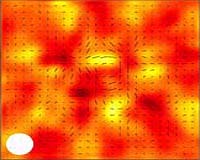
Chicago IL (SPX) Oct 08, 2004 New results from an instrument located high in the Chilean Andes are giving Canadian, American and Chilean researchers a clearer view of what the universe looked like in the first moments following the Big Bang. Cosmologists at the University of Toronto's Canadian Institute for Theoretical Astrophysics (CITA), along with fellow researchers from the United States and Chile, are using data from the Cosmic Background Imager (CBI) to observe a time in the universe's distant past when atoms were first forming. The findings reveal the first movements between these "seeds" that ultimately led to clusters of early galaxies. The new data also provides more proof supporting the accuracy of the standard inflationary model of the early universe, which suggests that the universe expanded rapidly in the first instants after the Big Bang. The findings appear in the October 7 online edition of Science Express. "The long-awaited detection of these tiny signals in the first light of the universe has been made possible thanks to these remarkable technological advances in experiments such as CBI," says University Professor Richard Bond, director of CITA and a co-author of the paper. "It has been our privilege at CITA to be fully engaged as members of the CBI team in unveiling these signals and interpreting their cosmological significance for what has emerged as the standard model of cosmic structure formation and evolution." CBI is a microwave telescope array made up of 13 separate antennas, each about three feet in diameter and operating in 10 frequency channels. It is located at Llano de Chajnantor, a high plateau in Chile 5,090 metres above sea level, making it by far the most sophisticated scientific instrument ever used at such high altitudes. The telescope is so high that members of the scientific team must carry bottled oxygen to work onsite. The cosmic background radiation observed by CBI originates from the era just 400,000 years after the Big Bang and provides a wealth of information on the nature of the universe. At this remote epoch none of the familiar structures of the universe existed: there were no galaxies, stars or planets, only tiny density fluctuations. The expanding universe cooled and by 400,000 years after the Big Bang it was cool enough for electrons and protons to combine to form atoms. The new data was collected by the CBI between September 2002 and May 2004. The results are based on a phenomenon of light known as polarization - CBI picks out the polarized light and it is the details of this light that reveal the motion of the seeds of galaxy clusters. Working in close partnership with their colleagues at the California Institute of Technology and the National Radio Astronomy Observatory, CITA scientists participated in every aspect of the research, from gathering data at the CBI site to providing complex analysis of the signals using the major supercomputing facilities at CITA. Anthony Readhead, the principal investigator on the CBI project and a professor of astronomy at the California Institute of Technology, says the new polarization results provide strong support for the standard model of the universe as a place in which dark matter and dark energy are much more prevalent than everyday matter. This poses a major problem for physics, according to Readhead, who explains that current physics has no explanation for why dark energy dominates the universe. The researchers are now attempting to refine the polarization observations and studying the total intensity and polarization signals in the hope of finding clues to the nature of the dark matter and dark energy. Funding for the research was provided by the Kavli Institute for Cosmological Physics, the California Institute of Technology, the National Science Foundation, the Chilean Center for Astrophysics, the Natural Sciences and Engineering Research Council of Canada, the Canadian Institute for Advanced Research and the Canada Foundation for Innovation. Related Links Kavli Institute for Cosmological Physics SpaceDaily Search SpaceDaily Subscribe To SpaceDaily Express
 Radio Astronomers Remove The Blindfold
 Manchester, UK (SPX) Oct 08, 2004
UK radio astronomers at the Jodrell Bank Observatory, working with colleagues from Europe and the USA, have demonstrated a new technique that will revolutionise the way they observe. To create the very best quality images of the sky, they routinely combine data from multiple telescopes from around the world � a technique called Very Long Baseline Interferometry (VLBI). |
|
|

| The content herein, unless otherwise known to be public domain, are Copyright 1995-2006 - SpaceDaily.AFP and UPI Wire Stories are copyright Agence France-Presse and United Press International. ESA PortalReports are copyright European Space Agency. All NASA sourced material is public domain. Additionalcopyrights may apply in whole or part to other bona fide parties. Advertising does not imply endorsement,agreement or approval of any opinions, statements or information provided by SpaceDaily on any Web page published or hosted by SpaceDaily. Privacy Statement |