. 24/7 Space News .
Modulating A Beam Of Light With Electricity

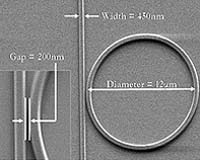
Scanning electron microscope image of the ring coupled to the waveguide with a zoom-in picture of the coupling region. See larger image. Credits: Cornell Nanophotonics Group.

Ithaca NY (SPX) May 20, 2005
Much of our electronics could soon be replaced by photonics, in which beams of light flitting through microscopic channels on a silicon chip replace electrons in wires.

Photonic chips would carry more data, use less power and work smoothly with fiber-optic communications systems. The trick is to get electronics and photonics to talk to each other.

Now Cornell University researchers have taken a major step forward in bridging this communication gap by developing a silicon device that allows an electrical signal to modulate a beam of light on a micrometer scale.

Other electro-optical modulators have been built on silicon, but their size is on the order of millimeters, too large for practical use in integrated circuit chips. (a micrometer, or micron, is one millionth of a meter, or one thousandth of a millimeter.)

Smaller modulators have been made using compound semiconductors such as gallium arsenide, but silicon is preferable for its ability to be integrated with current microelectronics.

The work is described in a paper published in the May 19, 2005, issue of Nature by Michal Lipson, Cornell assistant professor of electrical and computer engineering, and her research group.

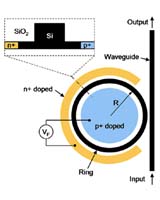
Their modulator uses a ring resonator - a circular waveguide coupled to a straight waveguide carrying the beam of light to be modulated. Light traveling along the straight waveguide loops many times around the circle before proceeding.


Related Links
Cornell Nanophotonics Group
SpaceDaily
Search SpaceDaily
Subscribe To SpaceDaily Express


Memory Foam Mattress Review
Newsletters :: SpaceDaily :: SpaceWar :: TerraDaily :: Energy Daily
XML Feeds :: Space News :: Earth News :: War News :: Solar Energy News


World's First UV 'Ruler' Sizes Up Atomic World
Boulder CO (SPX) May 19, 2005
The world's most accurate "ruler" made with extreme ultraviolet light has been built and demonstrated with ultrafast laser pulses by scientists at JILA, a joint institute of the National Institute of Standards and Technology (NIST) and the University of Colorado at Boulder.


  • Rutan Finds NASA Of Today Dull
  • Women Rising To The Challenge Of Weightlessness
  • Canadian Arrow Partners Form Planetspace
  • Space Race 2: Canadian Arrow Takes A Shot

  • Mars Global Surveyor Sees Mars Odyssey And Mars Express
  • Just A Little Bit Longer And Mars Rover Will Be Free
  • Designer Plants On Mars
  • Spirit Observing 'Reef'

  • Russian Space Program For 2006-2015 Worked Out
  • EADS Pulls Plug On New Bigger Version Of Ariane Rockets
  • NOAA-N Launch Delayed Until May 20
  • Russia To Launch Belorussian Satellite

  • Calipso Climatology Satellite On Its Way To California Launch Site
  • Satellites Join Watch On Naples' Volcanic Hinterland
  • Vietnam's Mekong Delta From Space During A Rare Cloudless Day
  • NASA's CloudSat Spacecraft Arrives At Launch Site

  • Preperation For Mission To Pluto And Beyond Continues
  • Ball Aerospace Delivers Imaging Instrument For NASA's Mission To Pluto
  • Case Of Sedna's Missing Moon Solved
  • Pluto's Horizon Gets Page One Treatment At NASA.gov

  • Canada's Space Scope Cracks Open A Massive Star
  • Canada's Space Scope Discovers Star Ringing Out Of Tune
  • Canadian Space Scope Detects Puzzling Brightness Variations In Dying Star
  • First-Ever Infrared Flash Challenges Notion Of Nature's Biggest Bang

  • NASA Announces New Centennial Challenge
  • Divining For Lunar Water?
  • Prospecting For Lunar Water
  • Don't Breathe the Moondust

  • Symmetricom Offers Anti-Spoofing Time/Frequency Generator
  • Garmin Hits The Road With Harley-Davidson
  • NovAtel GPS Receivers Deployed In China Port Container Terminals
  • Cubic's GPS-Based Tracking & Positioning Data Incorporated For First Time

  • The content herein, unless otherwise known to be public domain, are Copyright 1995-2006 - SpaceDaily.AFP and UPI Wire Stories are copyright Agence France-Presse and United Press International. ESA PortalReports are copyright European Space Agency. All NASA sourced material is public domain. Additionalcopyrights may apply in whole or part to other bona fide parties. Advertising does not imply endorsement,agreement or approval of any opinions, statements or information provided by SpaceDaily on any Web page published or hosted by SpaceDaily. Privacy Statement