| . |  |
. |
| . | |
. |


Messenger Ships To The Cape
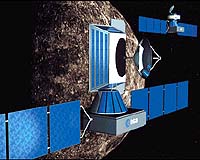
Laurel - Mar 10, 2004 NASA's Messenger spacecraft left home in Maryland today for Cape Canaveral, Fla., site of its scheduled May 11 launch toward Mercury and the first study of that planet from orbit. Secured in an air-conditioned moving van, Messenger set out from NASA's Goddard Space Flight Center in Greenbelt and will reach Kennedy Space Center/Cape Canaveral Air Force Station tomorrow, March 10. Messenger - short for Mercury Surface, Space Environment, Geochemistry, and Ranging - spent the past three months being baked, frozen, spun, shaken and probed in Goddard's test facilities, experiencing the conditions of launch and its upcoming five-year journey to the innermost planet. Over the next several weeks, engineers from the Johns Hopkins University Applied Physics Laboratory (APL) in Laurel, Md., where Messenger was designed and built, will prepare the spacecraft for launch at the Astrotech Space Operations facility near Kennedy Space Center. Other team members will continue to test the spacecraft's key operating systems remotely from the Messenger Mission Operations Center at APL. Set for a predawn launch aboard a Boeing Delta II rocket, Messenger will fly past Venus three times and Mercury twice before starting its yearlong orbital study of Mercury in July 2009. The Venus flybys, in November 2004, August 2005 and October 2006, use the planet's gravity to guide Messenger toward Mercury's orbit. Mercury flybys in October 2007 and July 2008 further tune Messenger's path and allow the spacecraft to gather data critical to planning the mission's orbital phase. The compact 1.2-ton spacecraft features several defenses against the intense heat and bright sunlight at Mercury, including a ceramic-fabric sunshade and a heat-radiation system. The mission's orbit design will also keep Messenger cooler by allowing it to pass only briefly through heat reflecting off the hottest spots on Mercury's surface, where temperatures can exceed 840 degrees Fahrenheit (450 degrees Celsius). Messenger is the next launch in NASA's Discovery Program of lower cost, highly focused space science investigations. Sean C. Solomon of the Carnegie Institution of Washington leads Messenger as principal investigator; APL manages the mission for NASA's Office of Space Science. Related Links Messenger at APL SpaceDaily Search SpaceDaily Subscribe To SpaceDaily Express
 Hubble's Deepest View Ever of the Universe Unveils Earliest Galaxies
 Baltimore - Mar 09, 2004
Astronomers at the Space Telescope Science Institute today unveiled the deepest portrait of the visible universe ever achieved by humankind. Called the Hubble Ultra Deep Field (HUDF), the million-second-long exposure reveals the first galaxies to emerge from the so-called "dark ages," the time shortly after the big bang when the first stars reheated the cold, dark universe. The new image should offer new insights into what types of objects reheated the universe long ago. |
|
|

| The content herein, unless otherwise known to be public domain, are Copyright 1995-2006 - SpaceDaily.AFP and UPI Wire Stories are copyright Agence France-Presse and United Press International. ESA PortalReports are copyright European Space Agency. All NASA sourced material is public domain. Additionalcopyrights may apply in whole or part to other bona fide parties. Advertising does not imply endorsement,agreement or approval of any opinions, statements or information provided by SpaceDaily on any Web page published or hosted by SpaceDaily. Privacy Statement |