| . |  |
. |
| . | |
. |


Mercury Sponge Technology Goes From Lab To Market
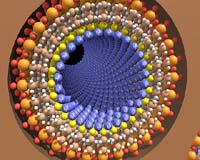
Richland WA (SPX) May 24, 2006 A material designed to capture and remove mercury and other toxic substances from industrial waste streams is now available for commercial use. Battelle has licensed the SAMMS technology developed at Pacific Northwest National Laboratory to Steward Environmental Solutions of Chattanooga, Tenn. Battelle operates the laboratory for the Department of Energy and transfers lab-developed technologies to the marketplace through licenses and other means. SAMMS, or Self-Assembled Monolayers on Mesoporous Supports, is a technology that can be tailored to selectively remove metal contaminants without creating hazardous waste or by-products. Steward intends to initially market use of the SAMMS for treating stack emissions from coal fired power plants, process industry and municipal facilities. In tests conducted at PNNL, 99.9 percent of mercury in simulated waste water was successfully removed. That reduction places the mercury levels well below the Environmental Protection Agency's discharge limits. This could equate to significant savings in disposal charges for users with mercury or other toxic metals in their facility waste streams, said Rick Skaggs, PNNL commercialization lead. According to Skaggs, SAMMS can be easily adapted to recover many toxic substances, including toxic metals such as lead, chromium, arsenic, as well as radionuclides. "PNNL is ready to expand upon the SAMMS platform to continue to develop new application technologies," Skaggs said. PNNL and Steward are investigating the capture of other metals from power plant emissions. Steward spokesman, Robert E. Jones, believes the economic and effective capture of mercury in aqueous and organic solutions also holds great promise for treating mercury-laden effluents. The company also expects to work with PNNL on other applications. "We intend to develop alternatives to traditional technologies that result in mercury going into fly ash by-products such as concrete or gypsum. SAMMS capabilities should be of great benefit to many process industries such as pulp and paper, the chemical industry, mining, and municipal waste operations," Jones explained. Steward Environmental Solutions began producing SAMMS on an industrial scale in March. "We now have commercial quantities of the material available, and are working with customers on specific applications," Jones said. EPA estimates that coal-fired power plants contribute about 48 tons of mercury to the United States environment each year. The Centers for Disease Control and Prevention estimates that one in eight women have mercury concentrations in their bodies that exceed safety limits. In March 2005, EPA issued the first federal rule to permanently cap and reduce mercury emissions from coal-fired power plants. This rule makes the United States the first country in the world to regulate mercury emissions from coal-fired power plants. PNNL was honored in February 2006 with a Federal Laboratory Consortium award for Excellence in Technology Transfer for the laboratory's development and commercialization of SAMMS. Related Links Pacific Northwest National Laboratory
 Managing Indian E-Waste
 New Delhi (UPI) May 26, 2006
A combination of greater affordability and a constant turnover in new computer technology is contributing to an e-waste problem never before encountered in India, leading to some serious thinking on how to manage a solution, say experts. |
|
|

| The content herein, unless otherwise known to be public domain, are Copyright 1995-2006 - SpaceDaily.AFP and UPI Wire Stories are copyright Agence France-Presse and United Press International. ESA PortalReports are copyright European Space Agency. All NASA sourced material is public domain. Additionalcopyrights may apply in whole or part to other bona fide parties. Advertising does not imply endorsement,agreement or approval of any opinions, statements or information provided by SpaceDaily on any Web page published or hosted by SpaceDaily. Privacy Statement |