|
 |
 |
 |
 |
 |
 |
 |
 |
 |

| . |  |
. |
Mars Odyssey Releases First Data Archive to Scientists
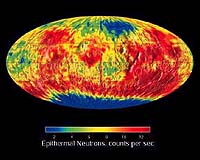
Pasadena - Oct 08, 2002 NASA last week released the first set of data taken by the Mars Odyssey spacecraft to the Planetary Data System, which will now make the information available to research scientists through a new online distribution and access system. "This release is a major milestone for Mars scientists worldwide, since the first validated data from our instruments are now available to the entire scientific community," said Dr. R. Stephen Saunders, the Odyssey project scientist at NASA's Jet Propulsion Laboratory, Pasadena, Calif. "There are fundamentally new kinds of information in these data sets, including day and night infrared images, maps of hydrogen in the soil, and radiation hazard data for future Mars missions." The information includes the first six weeks of mapping data through the end of March, as well as the observations made during the cruise phase to Mars. The archive consists of formatted instrument data from the gamma-ray spectrometer and high-energy neutron spectrometer; Mars maps from the neutron detectors; about 800 visible and infrared images taken by the camera system; and radiation measurements from the Martian radiation environment experiment. New data will be released to the science community every three months. Related Links Odyssey Data at Planetary Data System Guide to the Odyssey data sets Mars Odyssey SpaceDaily Search SpaceDaily Subscribe To SpaceDaily Express
 The New and Exciting and Messy Exploration of Space
 New York - Oct 08, 2002
The use of robots to help people has proceeded at a more or less steady clip since the first Unimation Robot was installed on a diecasting operation in the 1950's by the legendary Joe Engleberger. |
|
|

| The content herein, unless otherwise known to be public domain, are Copyright 1995-2006 - SpaceDaily.AFP and UPI Wire Stories are copyright Agence France-Presse and United Press International. ESA PortalReports are copyright European Space Agency. All NASA sourced material is public domain. Additionalcopyrights may apply in whole or part to other bona fide parties. Advertising does not imply endorsement,agreement or approval of any opinions, statements or information provided by SpaceDaily on any Web page published or hosted by SpaceDaily. Privacy Statement |