|
 |
 |
 |
 |
 |
 |
 |
 |
 |

| . |  |
. |
MIT Researchers Reassess Asteroid Hazards
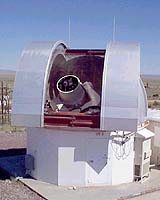
Monterey - Sep 11, 2003 Of the approximately 1,000 near-Earth asteroids larger than 1 kilometer in diameter, one strikes the Earth on average once every 600,000 years, MIT Lincoln Laboratory researcher J. Scott Stuart reported today (Sept. 5) at the 35th annual meeting of the American Astronomical Society Division for Planetary Sciences. By combining discovery statistics with new observations of the surfaces of near-Earth asteroids (NEAs), Stuart also determined that impacts similar to the Tunguska event-in which an asteroid destroyed more than 2,000 square kilometers of forest in a remote part of Siberia in 1908-are much less frequent than previously thought. Events of this magnitude occur, on average, once every 2,000 to 3,000 years. Near-Earth asteroids are small solar system objects whose orbits around the sun may bring them close to Earth. While all currently known NEAs are in safe orbits that will not cause them to collide with the Earth in the foreseeable future, many NEAs remain undetected and could be on a collision course with Earth, Stuart said. The Lincoln Near-Earth Asteroid Research (LINEAR) Project has been scanning the skies to discover and catalog NEAs and to provide advance warning of any that are bound for Earth. Since March 1998, LINEAR, whose principal investigator is Lincoln Lab associate division head Grant H. Stokes, has found 70 percent of all near-Earth asteroids discovered worldwide and is a major contributor to the NASA goal of cataloguing 90 percent of NEAs larger than 1 kilometer (0.6 miles) in diameter 2008. The amount of damage that would be caused by an asteroid depends on its size. Impacts of asteroids bigger than 1 kilometer are thought to be capable of causing long-term climate damage on a global scale. The NEA in the Tunguska event was relatively small, with a diameter of 50 to 75 meters (150-250 feet). The energy of the impact was about 40 megaton, or more than 600 times the energy of the Hiroshima bomb. Even if impacts of large NEAs occur only once every 600,000 years, this does not mean that they occur at regularly spaced intervals. This figure comes from looking at time spans of millions of years. Likewise, events similar to the Tunguska impact are not evenly spaced. Over long time spans, we might expect such events to occur every 2,000 to 3,000 years on average, Stuart said.
Reflecting Sunlight Through new observations and modeling of the reflective properties of the NEAs, MIT researchers have found that on average, NEAs actually reflect about 14 percent of the sunlight that hits them. This means that NEAs are slightly smaller than previously assumed, so the number of NEAs that are larger than 1 kilometer is somewhat lower than previously estimated. To determine the percentage of sunlight that is reflected from NEAs, MIT researchers used results from the Small Main-belt Asteroid Spectroscopic Survey (SMASS), a multi-wavelength observing program that studies the surface properties of NEAs and other asteroids. This program comprises visible spectroscopy, near-infrared spectroscopy and thermal infrared flux measurements. The visible spectroscopy is collected at Kitt Peak National Observatory and Palomar Observatory, and on the Magellan I Telescope at Las Campanas Observatory. Near-infrared spectroscopy is collected at the NASA Infrared Telescope Facility. The W. M. Keck Observatory is used to obtain thermal flux measurements to estimate reflectivity. SMASS is directed by MIT's Richard P. Binzel, professor of earth, atmospheric and planetary sciences (EAPS), and operates in collaboration with the University of Hawaii, the Space Science Institute in Boulder, Colo., and the Deutschen Zentrum f�r Luft- und Raumfahrt in Berlin and others.
Moon Impacts The rate of crater formation expected from the NEAs matches the observable counts of craters from the lunar maria. Because current NEA population matches the crater counts from the lunar maria, the NEA population has been roughly in equilibrium for billions of years. In other words, new asteroids are introduced into near-Earth space at around the same rate that old NEAs are destroyed by collisions with the planets and the sun or are ejected from the solar system. Stuart, a member of the LINEAR project team, is an EAPS alumnus of MIT. Related Links Lincoln Near-Earth Asteroid Research Project SpaceDaily Search SpaceDaily Subscribe To SpaceDaily Express
 NASA Releases Near-Earth Object Search Report
 Pasadena - Sep 11, 2003
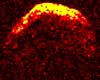
NASA has released a technical report on potential future search efforts for near-Earth objects after a year of analysis by scientists working on this issue. This Science Definition Team was chartered to study what should be done to find near-Earth objects less than 1 kilometer in size. |
|
|

| The content herein, unless otherwise known to be public domain, are Copyright 1995-2006 - SpaceDaily.AFP and UPI Wire Stories are copyright Agence France-Presse and United Press International. ESA PortalReports are copyright European Space Agency. All NASA sourced material is public domain. Additionalcopyrights may apply in whole or part to other bona fide parties. Advertising does not imply endorsement,agreement or approval of any opinions, statements or information provided by SpaceDaily on any Web page published or hosted by SpaceDaily. Privacy Statement |