| . |  |
. |
| . | |
. |


Lunar Region Receiving Permanent Sunlight Opens Way For Future Colony
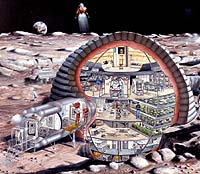
Paris (AFP) Apr 13, 2005 Astronomers say they have identified a place on the Moon that lies in permanent sunlight and close to regions suspected to hold water ice: in short, an ideal location for a tentative lunar colony. The spot is located on a highland close to the lunar north pole, between three large impact craters called Peary, Hermite and Rozhdestvensky, they report in Thursday's issue of Nature, the British weekly science journal. The temperature there is estimated to range between minus 40 and minus 60 C (minus 40 to minus 76 F), which by lunar standards is relatively balmy - and stable. By comparison, the temperature on the Moon's equator ranges from minus 180 C to plus 100 C (minus 292 to plus 212 F). Because the area is bathed in perpetual sunlight, a future human outpost on the Moon could draw on abundant solar energy. In addition, the lunar pioneers could tap into supplies of water if - as some scientists speculate - ice lurks in permanently shadowed craters at the lunar poles. The study is lead-authored by Ben Bussey of Johns Hopkins University, Maryland. In January 2004, President George W. Bush sketched plans for a US return to the Moon as early as 2015, saying a lunar base would be a launch pad for manned missions to Mars and "across our Solar System." Related Links SpaceDaily Search SpaceDaily Subscribe To SpaceDaily Express
 ESA Council Gives Go-Ahead To Cooperation With India's Lunar Mission
 Paris (ESA) Apr 13, 2005
On 17 March the ESA Council, at its meeting in Paris, unanimously approved a cooperation agreement between ESA and the Indian Space Research Organisation for India's first moon mission - Chandrayaan-1. |
|
|

| The content herein, unless otherwise known to be public domain, are Copyright 1995-2006 - SpaceDaily.AFP and UPI Wire Stories are copyright Agence France-Presse and United Press International. ESA PortalReports are copyright European Space Agency. All NASA sourced material is public domain. Additionalcopyrights may apply in whole or part to other bona fide parties. Advertising does not imply endorsement,agreement or approval of any opinions, statements or information provided by SpaceDaily on any Web page published or hosted by SpaceDaily. Privacy Statement |