| . |  |
. |
| . | |
. |


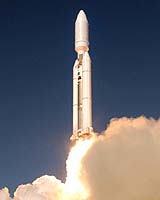
Lockheed Martin's Last Titan IV Delivers National Security Payload To Space
Vandenberg AFB CA (SPX) Oct 19, 2005 The United States Air Force and Lockheed Martin closed out a proud five-decade history today with the final launch of a Titan IV B rocket carrying a critical national security payload for the National Reconnaissance Office (NRO). All eyes were on Space Launch Complex 4 East as the nation's heavy-lift workhorse thundered off the pad to deliver its final payload to space and retire from service. "Today's spectacular launch is a fitting way to say goodbye to Titan," said G. Thomas Marsh, executive vice president of Lockheed Martin Space Systems Company. "The Lockheed Martin employees who have given their utmost efforts to the program over the years join with our Air Force and NRO customers, and the many other organizations that make up the Titan team, in expressing our great pride in this service to our country's space program." Today's launch was the last launch for the Titan IV and the culmination of a long evolution from the original Titan I intercontinental ballistic missile. In all, 39 Titan IVs have been launched - 12 Titan IVs have been launched from Vandenberg Air Force Base on the West Coast plus 27 more from the Cape Canaveral Air Force Station, Fla. The final Titan IV mission from Cape Canaveral was launched successfully April 29, 2005. Col. Michael T. Baker, director, Launch Programs, Space and Missile Systems Center, Air Force Space Command, said, "The members of the System Program Office are extremely proud to be part of this historic launch. I am particularly honored to lead this SPO since Titan has been a part of my career since 1981. We have been confident from the beginning that the Titan team would deliver one final mission success for the nation." Following the Space Shuttle Challenger tragedy in 1986, when assured access to space became critical for the U.S. government, the Titan IV was developed as the booster used to launch the nation's largest, heaviest and most critical payloads. Titan initial IV A design was followed by Titan IV B with a new generation of large solid rocket motors, state-of-the-art guidance and electronics and a new ground processing system. "Today's launch marks the end of an NRO Titan era but the beginning of the Titan Legend that will live on in the history of America's space program," said Col. Chip Zakrzewski, National Reconnaissance Office mission director. Lockheed Martin Space Systems Company built the Titan IVs near Denver, Colo., under contract to the U.S. government. As prime contractor and systems integrator, the company built the first and second stages and provides overall program management and launch services. Other members of the Titan IV contractor team and their responsibilities include: GenCorp Aerojet Propulsion Division, Sacramento, Calif., liquid rocket engines; Alliant Techsystems, Magna, Utah, solid rocket motor upgrade; The Boeing Company, Huntington Beach, Calif., payload fairing; and Honeywell Space Systems, Clearwater, Fla., advanced guidance. Related Links SpaceDaily Search SpaceDaily Subscribe To SpaceDaily Express
 Official: Secrecy Decisions 'Subjective'
 Washington (UPI) Oct 18, 2005
The official in charge of the Pentagon's use of secrecy acknowledged Tuesday that there was too much subjectivity in the way decisions about classification were made. |
|
|

| The content herein, unless otherwise known to be public domain, are Copyright 1995-2006 - SpaceDaily.AFP and UPI Wire Stories are copyright Agence France-Presse and United Press International. ESA PortalReports are copyright European Space Agency. All NASA sourced material is public domain. Additionalcopyrights may apply in whole or part to other bona fide parties. Advertising does not imply endorsement,agreement or approval of any opinions, statements or information provided by SpaceDaily on any Web page published or hosted by SpaceDaily. Privacy Statement |