|
 |
 |
 |
 |
 |
 |
 |
 |
 |

| . |  |
. |
Life on Mars Pregnancy Test Launched
Washington DC (SPX) Sep 20, 2007 Key components of a new approach to discover life on Mars were successfully launched into space Friday as part of a twelve-day, low-Earth orbit experiment to assess their survivability in the space radiation environment Na prelude to future journeys to Mars. The new approach is based on technology similar to that used in pregnancy test kits. The so-called immunoassays are embodied in the "Life Marker Chip" (LMC) experiment, which has the potential to detect trace levels of biomarkers in the Martian environment. Biomarkers are molecular fingerprints that indicate if life currently is, or ever was, present on Mars. The LMC experiment has been proposed for the European Space AgencyOs ExoMars rover mission, which is planned for launch in 2013. The LMC experiment is in the development phase and is led by an international consortium with researchers including Andrew Steele, a staff member of CarnegieOs Geophysical Laboratory in the United States, and scientists from the United Kingdom, The Netherlands, and Germany. For the current mission, the consortium developed a tiny component, measuring only 1.5 inches x 1.6 inches x .5 inch ( 3.8 cm x 4.1 cm x 1.3 cm) and housing over 2000 samples, to test that the key molecular components to be used in the LMC technology can survive the rigors of space. The experiment was launched from Baikonur Cosmodrome in Kazakhstan as part of the European Space AgencyOs BIOPAN-6 experiment platform. The LMC components will experience both weightlessness and the harsh space radiation environment while orbiting the Earth 180 times at an altitude of up to 190 miles (308 km) during the 11.8 day mission. The BIOPAN-6 platform is mounted on the outside of an un-manned Russian FOTON spacecraft. Once in space the BIOPAN-6 platform will open to expose its contents directly to the space environment, testing both their resistance to space radiation and the space vacuum, before closing and returning to Earth on September 25th. The LMC components will then be taken back to laboratories in the United Kingdom and the United States to analyze the effect of the space flight. The lead members of the consortium involved in the current mission are Deutsches Zentrum f'r Luft- und Raumfahrt (DLR) (Germany), Cranfield University (UK), Carnegie Institution of Washington (USA) and University of Leicester (UK). Dr. Andrew Steele from the Carnegie Institution of Washington (USA) and one of the initial experiment proposers said, "in the USA we are currently flying related technology and components within the protected environment of the International Space Station (ISS) but this will be the first time that these types of materials will have flown unprotected in space in a manner similar to a flight to Mars." Dr. Lutz Richter of DLR (Germany) and the principal investigator for the current experiment said, 'This experiment is the culmination of a number of years of hard work and ground based tests to prove the viability of the LMC technology." Dr. David Cullen, from Cranfield University (UK) and who leads the scientific input into the current experiment, said, "this will be our first space experiment to demonstrate our belief that immunoassay technology will have an important future role in space exploration and the search for life elsewhere in the Solar System.' Dr. Mark Sims from the University of Leicester (UK) and who heads the overall LMC project said, "this mission will be an important stepping stone in our ultimate goal of putting a LMC experiment on the surface of Mars and using it to search for evidence of Life." A number of other people, organizations and companies have contributed to the experiment and these include Haptogen Ltd. (Aberdeen, UK), Oklahoma State University (USA), LioniX BV (Enschede, NL), Technische Universit't Munchen (Germany) and Dr Jan Toporski, formally of Christian-Albrechts-Universit?t zu Kiel (Germany). Community Email This Article Comment On This Article Related Links Cranfield University Mars News and Information at MarsDaily.com Lunar Dreams and more
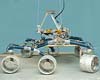
 Changes to Mars Science Lab Project Respond to Cost Increases And Keep Program On Track
 Pasadean CA (JPL) Sep 19, 2007
In early June 2007, the Mars Science Laboratory project completed its project-wide Critical Design Review (CDR), which marks the completion of the project's design phase and transition into the build up of flight hardware. A key component of the CDR process was a technical risk, programmatic, and cost review, from which multiple independent cost assessments predicted that this technically challenging $1.7B planetary science rover mission's current content would cause it to exceed its budgeted development costs to launch by approximately $75M. |
|
|

| The content herein, unless otherwise known to be public domain, are Copyright 1995-2007 - SpaceDaily.AFP and UPI Wire Stories are copyright Agence France-Presse and United Press International. ESA Portal Reports are copyright European Space Agency. All NASA sourced material is public domain. Additional copyrights may apply in whole or part to other bona fide parties. Advertising does not imply endorsement,agreement or approval of any opinions, statements or information provided by SpaceDaily on any Web page published or hosted by SpaceDaily. Privacy Statement |