





Applications for SOLIS100 and SMC3 are open until 12 December 2025 via the website dlr-probandensuche.de. Candidates will pass through a multi stage medical and psychological selection process before final crews are chosen.
SOLIS100 is an ESA initiated investigation into how prolonged isolation and confinement affect health, performance and wellbeing. Six people will live for 100 days inside a simulated space station with limited resources in :envihab, following routines similar to those of astronauts: working as a crew, conducting experiments, exercising and maintaining their habitat. The campaign follows the eight day SOLIS8 trial completed in July 2025, in which three men and three women rehearsed an analog mission in the same facility and carried out tasks such as docking a virtual spacecraft under simulated microgravity conditions.
The isolation study is framed against the demands of exploration missions that will extend far beyond the three day trip to the Moon. A journey to Mars takes about six months when Earth and Mars are favorably aligned, and even at their closest the two planets are separated by at least 55 million kilometers, compared with about 380,000 kilometers to the Moon. Crews travelling these distances must work effectively with one another, adapt to the habitat and distance from Earth, manage limited resources and sustain performance over months in an extreme environment.
"Future space missions will go beyond Earth's orbit and target distant destinations such as the Moon or Mars. As these missions involve long periods in weightlessness, it is more important than ever to prepare astronauts for the psychological and physiological challenges," says Amelie Therre, head of SOLIS100 at the DLR Institute of Aerospace Medicine. "Missions to the Moon and Mars require mental and physical resilience, independence and the ability to thrive in isolated and confined environments. To carry out such missions successfully and ensure the safety of astronauts, we must investigate the effects of these extreme conditions on human health, behaviour and performance."
The SOLIS100 crew will be drawn from an international pool of applicants with astronaut like profiles. Volunteers must be between 25 and 55 years old, in good physical condition and hold at least a bachelor's degree, with advanced degrees and relevant technical or scientific expertise considered an advantage. The team will evaluate suitability using questionnaires, tests and clinical examinations, and very good English skills are required because English is the working language of the study. Including preparation and recovery, each participant will be involved in SOLIS100 for 126 days, with the main isolation phase currently planned to start in April 2026.
In parallel, the Sensorimotor Countermeasure Study campaign 3 (SMC3) will run at :envihab as a collaboration between DLR and NASA to test countermeasures against sensorimotor and musculoskeletal impairments caused by weightlessness. The core intervention is 60 days of strict bed rest in a six degree head down tilt, which shifts body fluids toward the head and induces changes in muscles and balance similar to those seen in orbit. The full SMC3 protocol lasts 88 days per subject, including pre and post bed rest phases.
"Future astronauts will be exposed to prolonged periods of microgravity, working on the surface of the Moon - where gravity is only one-sixth of Earth's - and returning to the space station in lunar orbit. They must be able to move properly and safely and require strength. However, future space stations will have limited space for large training equipment. The study investigates how relatively small, lightweight training methods can help preserve musculoskeletal function. To do this, we first simulate the effects of weightlessness. The participants do not just lie in bed for 60 days. The bed is also tilted down by six degrees towards the head, which means the head is lower than the feet. The body then shifts fluids towards the head, as they do in microgravity. Just as with astronauts, muscle mass then decreases and the sense of balance deteriorates," explains Stefan Mostl from the DLR Institute of Aerospace Medicine, who is leading the bed rest study.
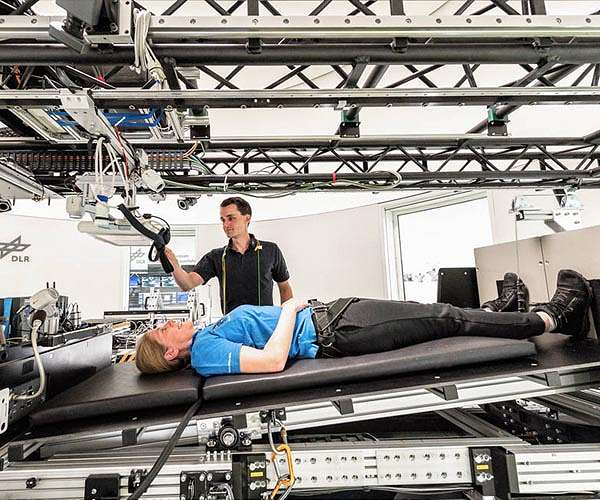
SMC3 will divide its 12 "terrestrial astronauts" into three groups. One group will serve purely as a control and remain in six degree head down tilt without any added training. A second group will work with the GravityBed system, in which volunteers "float" on a compressed air supported sled and press their feet against a balance board via a strap system, stabilizing the board through leg and trunk movements to train balance and coordination. The third group will perform only electromyostimulation sessions that activate leg muscles with electrical impulses, a compact countermeasure that, like GravityBed, could be deployed in the confined volume of future stations.
For the bed rest campaign, DLR is seeking healthy men and women aged 24 to 55 years, with heights between 1.53 and 1.90 meters and a body mass index between 18 and 28 kilograms per square meter. Participants should have an average level of fitness and good German language skills. As with SOLIS100, applicants first complete an online questionnaire and then proceed through further screening stages before admission to the 88 day protocol at :envihab. Detailed calls for participants for both SOLIS100 and SMC3 are available through dedicated information pages linked from the DLR study recruitment site.
Related Links
German Aerospace Center DLR Institute of Aerospace Medicine
Space Medicine Technology and Systems
| Subscribe Free To Our Daily Newsletters |

| Subscribe Free To Our Daily Newsletters |








