| . |  |
. |
| . | |
. |


 by Staff Writers Edmonton, Canada (SPX) Aug 08, 2018
The oxygenation of Earth's atmosphere was thanks, in part, to iron and silica particles in ancient seawater, according to a new study by geomicrobiologists at the University of Alberta. But these results solve only part of this ancient mystery. Early organisms called cyanobacteria produced oxygen through oxygenic photosynthesis, resulting in the oxygenation of Earth's atmosphere. But cyanobacteria needed protection from the sun's UV radiation in order to evolve. That's where iron and silica particles in ancient seawater come in, according to Aleksandra Mloszewska, a former PhD student who conducted this research under the supervision of Kurt Konhauser, professor in the Department of Earth and Atmospheric Sciences, and George Owttrim, professor in the Department of Biological Sciences. The research team characterized the effect of UV stress on cyanobacteria and the degree of radiation through the seawater medium through a combination of microbiological, spectroscopic, geochemical and modelling techniques. Their results show that the presence of high silica and iron concentrations in early sea water allowed for the formation of iron-silica precipitates that remained suspended in the ocean for extended periods of time. "In effect, the iron-silica particles acted as an ancient 'sunscreen' for the cyanobacteria, protecting them from the lethal effects of direct UV exposure," said Konhauser, the senior author from UAlberta. "This was critical on the early Earth before a sufficiently thick ozone layer was established that could enable marine plankton to spread across the globe, as is the case today."
More missing pieces "The accumulation of atmospheric oxygen from cyanobacterial facilitated the evolution of oxygen-based respiration and multicellular organisms," says Owttrim. But the reason for the large amount of time that it took for free oxygen to accumulate permanently in the atmosphere after the initial evolution of cyanobacteria remains a mystery. While iron-silica precipitates would have allowed early cyanobacteria to survive, UV radiation would still have prevented their widespread growth. "It is likely that early cyanobacteria would not have been as productive as they are today because of the effects of UV stress. Until the accumulation of sufficient cyanobacteria-derived oxygen allowed a more permanent means of protection to develop, such as an ozone layer, UV stress may have played an even more important role in shaping the structure of the earliest ecosystems," explained Mloszewska. These new findings are helping researchers to understand not only how early cyanobacteria were affected by the high level of radiation on the early Earth but also the environmental dynamics that affected the oxygenation history of our atmosphere. "These findings could also be used as a case study to help us understand the potential for the emergence of life on other planets that are affected by elevated UV radiation levels, for example Earth-sized rocky planets within the habitable zones of nearby M-dwarf star systems like TRAPPIST-1, Proxima Centauri, LHS 1140 and Ross 128 among others," said Mloszewska. The research was conducted in collaboration with colleagues at the University of Tuebingen and Yale University and was supported by the National Science and Research Council of Canada, and by the NASA Alternative Earths Astrobiology Institute. The paper, "UV radiation limited the expansion of cyanobacteria in early marine photic environments" is published in Nature Communications.
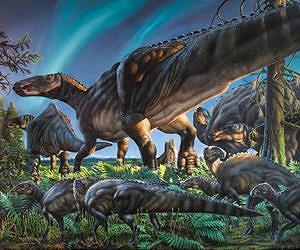
Fossils suggest Alaska served as superhighway for migrating dinosaurs Washington (UPI) Aug 6, 2018 New fossils suggest hadrosaurs and therizinosaurs migrated between Central Asia and North America 100 million years ago. The ancient dinosaur remains, dated to the Late Cretaceous, were recovered from the Cantwell Formation in Alaska's Denali National Park. The discovery marked the first time hadrosaur and therizinosaur bones have been found together in North America. Hadrosaurs, known as duck-bill dinosaurs, were abundant in what is now Alaska, but therizinosaurs, unusual, long-necked h ... read more
|
|||||||||||||
| The content herein, unless otherwise known to be public domain, are Copyright 1995-2026 - SpaceDaily. All websites are published in Australia and are solely subject to Australian law and governed by Fair Use principals for news reporting and research purposes. By using our websites you consent to cookie based advertising. If you do not agree with this then you must stop using the websites from May 25, 2018. Privacy Statement. Additional information can be found here at About Us. |


 del.icio.us
 Digg
Digg Reddit
 Google







