| . |  |
. |
| . | |
. |


International Space Station Marks Five Years In Orbit
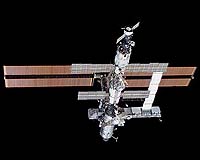
Houston - Nov 20, 2003 The International Space Station reaches the historic five years in space milestone on November 20, 2003. The unique orbiting laboratory complex has grown from a lone, uninhabited module into a permanently staffed, house-sized research facility. The Station remains the largest and most complex international space research project in history. The Station will eventually triple scientific capacity with components awaiting the Space Shuttle's return to flight. The first Space Station element, the Russian Zarya control module, was launched from Baikonur, Kazakhstan, Nov. 20, 1998. Two weeks later, the Space Shuttle Endeavour delivered the second element, the U.S. connecting module called Unity. The challenges, triumphs and tragedy shared by the international partnership since then have solidified cooperation on the Station among the United States, Russia, Canada, Japan and Europe. "Together with our international partners we have learned how to build, operate and maintain a very complex spacecraft, through the good times and the bad," said Bill Gerstenmaier, NASA Space Station Program Manager. "With this experience to guide us, we look forward to the future, with a vast expansion of the Station on the horizon." At five years old, the Station is still growing. More than 80 tons of equipment and hardware are in the Space Station Processing Facility at NASA's Kennedy Space Center (KSC), Fla. Being prepared for launch. The Space Station has orbited the Earth more than 29,000 times. It is visible in the night sky as it flies more than 210 miles overhead. The living and working area inside the Station has a volume of about 15,000 cubic feet, larger than a three-bedroom house. The orbiting complex has been inhabited since Nov. 2, 2000. Eight successive crews, 22 people, have staffed the Station. Residents have conducted research in bioastronautics, physical sciences, fundamental space biology, space product development and space flight disciplines. In the U.S. Destiny Lab alone, astronauts have worked on over 70 different science experiments. Hundreds of people on Earth support Station operations from the Station Mission Control Center at NASA's Johnson Space Center in Houston. Round-the-clock science operations are handled by the Payload Operations Center team at NASA's Marshall Space Flight Center in Huntsville, Ala. Hundreds of other scientists and engineers perform important jobs, such as training Station crews and building new hardware that will become part of the orbiting laboratory. Additional research facilities are being readied for launch on future Shuttle missions. They will enhance Destiny's capabilities in the areas of fundamental space biology; glass and porous ceramics materials processing research; human physiology research; combustion research; research on the behavior of fluids; Earth observations; and experiment refrigerator/freezer conditioned sample storage. Also awaiting launch at KSC are solar arrays and support structures that will triple the sunlight-gathering, solar cell area, thereby increasing the power dedicated to research by 84 percent. The Node 2 module that will serve as a connector between the U.S., European and Japanese research labs is at KSC undergoing pre-launch processing. The Kibo Japanese Experiment Module, including a pressurized lab already at KSC, will also be added to the Station. The European Columbus Laboratory, under construction in Bremen, Germany, will expand the Station's volume to almost that of a five-bedroom house. Related Links Stations at NASA SpaceDaily Search SpaceDaily Subscribe To SpaceDaily Express
 NASA's Gateway To Space For Life Science Research Opened
 KSC - Nov 20, 2003
The Space Life Sciences (SLS) Laboratory was dedicated today in a ceremony hosted by NASA's Kennedy Space Center (KSC) and the state of Florida. |
|
|

| The content herein, unless otherwise known to be public domain, are Copyright 1995-2006 - SpaceDaily.AFP and UPI Wire Stories are copyright Agence France-Presse and United Press International. ESA PortalReports are copyright European Space Agency. All NASA sourced material is public domain. Additionalcopyrights may apply in whole or part to other bona fide parties. Advertising does not imply endorsement,agreement or approval of any opinions, statements or information provided by SpaceDaily on any Web page published or hosted by SpaceDaily. Privacy Statement |