


|
|
|
|
|
|
|
|
|
|
|


| . |  |
. |
|
|
|
 by Staff Writers Gobabeb, Namibia (AFP) July 11, 2008
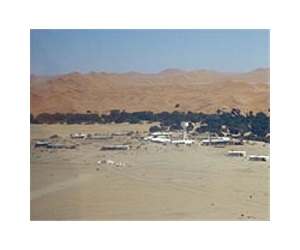
It was never easy living among the Namib desert's spectacular vistas, with ancient camel thorn trees providing sparse shade and huge red sand dunes reflecting the burning hot sun. But signs that climate change may be worsening the already harsh conditions in this patch of desert have led to novel experiments and skillful improvisation under some of the world's hottest weather. Scientists toil at the privately run Gobabeb research station -- a center appropriately powered by solar panels -- to come up with new ways of collecting water that could help local farmers. Nearby uranium mines are meanwhile paying for the construction of a desalination plant to cover their needs. Such projects are vital, with water demand expected to exceed ground water extraction capacity by 2015, posing a major risk in such a dry country. Leon Jooste, the country's deputy environment minister, said climate change could severely impact Namibia's agriculture, and Gobabeb's experiments will help address the problem. "Most agricultural activities of our country depend on rainfall," Jooste said. Without it, "livestock has no grazing and crops cannot be harvested." Started in 1962, Gobabeb has gained an international reputation among scientists for its biodiversity and underground water supply research in the Namib. One of its experiments involves harvesting morning fog from the nearby coast with screens. The fog condenses into water that is then sent through a pipe. -- 'We've had to plant crops later' -- -------------------------------------- Namibia is the driest country in sub-Saharan Africa, with annual rainfall varying between 30 millimetres (1.2 inches) in the desert to as much as 500 millimetres in the extreme northeastern Caprivi Region. Climate change may already be making the situation worse. "Recent analysis of the country's climate data, which stretch over a hundred years, shows an observable increase in temperature of approximately one to 1.2 degrees Celsius," Namibia's Renewable Energy and Energy Efficiency Institute (REEEI) said in a report published in June. "In recent years, hot temperatures are getting hotter, hot days of above 35 degrees Celsius are becoming more frequent and the number of cold nights decreasing." Rainfall seasons are already starting later and ending earlier, affecting subsistence farmers who grow staple foods maize and mahangu (pearl millet). "For the last few years we've had to plant these crops later -- January, February -- and harvest later as well -- July instead of May -- because it rains late," said Bollen Masule, a Caprivi communal farmer. The Namib Desert, considered one of the world's oldest, stretches some 1,400 kilometres (875 miles) from the Orange River in the south to the Kunene River, which forms the border with Angola. Concerns over water shortages extend beyond agriculture to include Namibia's key uranium mining industry. Not far from Gobabeb, a sign explains plans for a nearby uranium mine -- one of 12 new uranium mines that have applied for approval with the government. Two open pit mines are already active. "We are constructing a water desalination plant at the coast to accommodate the water needs of those new mines," said Vaino Shivute, head of the Namibian Water Corporation (NamWater). The project is worth 1.2 billion Namibian dollars (160 million dollars, 102 million euros). It however only benefits the mines, which must pay for it, not nearby coastal towns for now. Once uranium is depleted in about 20 years, the desalinated water will flow for the towns.
Related Links Climate Science News - Modeling, Mitigation Adaptation
|
|
|
| The content herein, unless otherwise known to be public domain, are Copyright 1995-2014 - Space Media Network. AFP, UPI and IANS news wire stories are copyright Agence France-Presse, United Press International and Indo-Asia News Service. ESA Portal Reports are copyright European Space Agency. All NASA sourced material is public domain. Additional copyrights may apply in whole or part to other bona fide parties. Advertising does not imply endorsement,agreement or approval of any opinions, statements or information provided by Space Media Network on any Web page published or hosted by Space Media Network. Privacy Statement |
 del.icio.us
 Digg
Digg Reddit
 Google