



|
|
|
|
|
|
|
|
|
|
|


| . |  |
. |
|
|
|
 by Staff Writers Huntsville AL (SPX) Jul 11, 2008
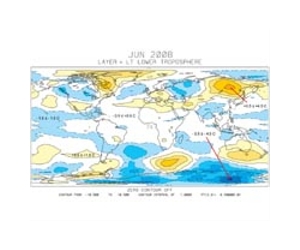
A La Nina Pacific Ocean cooling event continues to drive tropical and global temperatures: Globally, June 2008 was the coolest June since 1999, according to Dr. John Christy, director of the Earth System Science Center at The University of Alabama in Huntsville. While the La Nina is a tropical event, cool temperatures covered a large portion of the globe. Among the past 30 Junes, June 2008 was the third coldest south of the Antarctic Circle, fourth coolest in the Southern Hemisphere and fifth coolest in the tropics. The Antarctic continent saw its third coldest June in 30 years, with temperatures averaging -1.53 C cooler than the seasonal norm. Portions of Anarctica south of Australia were as much as 5.5 C (9.9 degrees Fahrenehit) colder than seasonal norms for the first month of winter. While La Nina has caused global average temperatures to fall by more than 0. 7 C (about 1.26 degrees F) since January 2007, June was only the eleventh cooler than normal month since January 1999. Global trend since Nov. 16, 1978: +0.13 C per decade June temperatures (preliminary): Global composite temp.: -0.11 C (about 0.32 degrees Fahrenheit) below 20-year average for June. Northern Hemisphere: 0.00 C (about 0.00 degrees Fahrenheit) above 20-year average for June. Southern Hemisphere: -0.23 C (about 0.56 degrees Fahrenheit) below 20-year average for June. May temperatures (revised): Global Composite: -0.18 C below 20-year average Northern Hemisphere: -0.05 C below 20-year average Southern Hemisphere: -0.31 C below 20-year average (All temperature variations are based on a 20-year average (1979-1998) for the month reported.) As part of an ongoing joint project between UAH, NOAA and NASA, Christy and Dr. Roy Spencer, a principal research scientist in the ESSC, use data gathered by microwave sounding units on NOAA and NASA satellites to get accurate temperature readings for almost all regions of the Earth. This includes remote desert, ocean and rain forest areas for which reliable climate data are not otherwise available. The satellite-based instruments measure the temperature of the atmosphere from the surface up to an altitude of about eight kilometers above sea level. Once the monthly temperature data is collected and processed, it is placed in a "public" computer file for immediate access by atmospheric scientists in the U.S. and abroad. Neither Spencer nor Christy receives any research support or funding from oil, coal or industrial companies or organizations, or from any private or special interest groups. All of their climate research funding comes from state and federal grants or contracts.
Related Links University of Alabama Huntsville Climate Science News - Modeling, Mitigation Adaptation
|
|
|
| The content herein, unless otherwise known to be public domain, are Copyright 1995-2014 - Space Media Network. AFP, UPI and IANS news wire stories are copyright Agence France-Presse, United Press International and Indo-Asia News Service. ESA Portal Reports are copyright European Space Agency. All NASA sourced material is public domain. Additional copyrights may apply in whole or part to other bona fide parties. Advertising does not imply endorsement,agreement or approval of any opinions, statements or information provided by Space Media Network on any Web page published or hosted by Space Media Network. Privacy Statement |
 del.icio.us
 Digg
Digg Reddit
 Google