24/7 Space News
WATER WORLD
Hydrogen plasma method cuts most CO2 from deep sea metal extraction
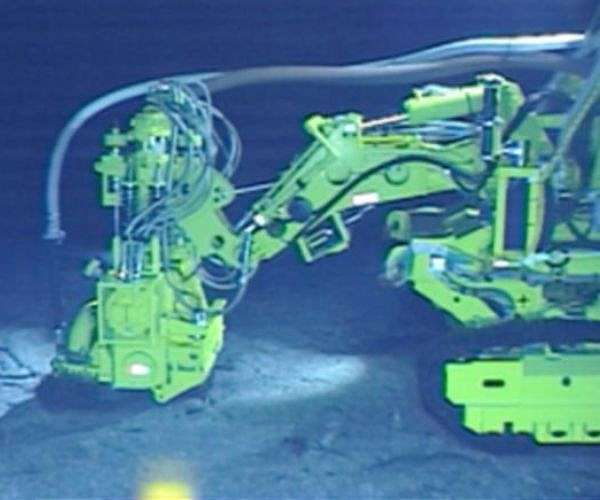
illustration only

Hydrogen plasma method cuts most CO2 from deep sea metal extraction

by Robert Schreiber
Berlin, Germany (SPX) Dec 05, 2025

Researchers at the Max Planck Institute for Sustainable Materials report that deep sea manganese nodules could supply large volumes of copper, nickel and cobalt for the energy transition if mining and processing are managed to limit environmental damage.

They note that global demand by 2050 could reach about 60 million tonnes of copper for motors and grids, plus up to 10 million tonnes of nickel and 1.4 million tonnes of cobalt for batteries, implying more than a doubling of copper and nickel demand and a fivefold increase for cobalt relative to current levels. The team emphasizes that land-based mining of these metals already leads to extensive deforestation, generates 4 to 5 billion tonnes of waste rock and slag each year, and in the case of cobalt often relies on child labor according to UNICEF assessments.

The press release highlights deep sea polymetallic nodules in the Clarion-Clipperton Zone of the Pacific as an alternative resource because they contain manganese along with significant copper, nickel and cobalt.

A Max Planck team has demonstrated a smelting route in which dried deep sea ores are reduced with hydrogen in an electric arc furnace to extract these metals with much lower CO2 emissions than carbon-based processes. In the journal Science Advances they compare their hydrogen-based approach with the process used in the Nori-D project of Canadian company TMC, which relies on carbonaceous compounds for reduction.

According to the study, using hydrogen as the reductant can cut CO2 emissions from deep sea ore processing by more than 90 percent when combined with green hydrogen and renewable electricity. The researchers also calculate that their route uses nearly 20 percent less energy overall and requires fewer process steps than the carbon-based alternative. They stress, however, that deep sea mining itself still creates environmental pressures, so any deployment must be evaluated within a broader life cycle assessment.

Director Dierk Raabe states that he previously opposed deep sea mining to avoid repeating the impacts of terrestrial extraction but has reconsidered under strict environmental conditions. He argues that extraction of metals from deep sea nodules would avoid child labor and substantially reduce deforestation and waste compared to land deposits.

For one billion electric car batteries, University of Delaware researchers estimate that land deposits would generate around 63 billion tonnes of waste rock, whereas sourcing the same metals from deep sea ores would produce about 9 billion tonnes of rock waste.

Doctoral researcher Ubaid Manzoor explains that the group reduces dried deep sea ores directly in an electrically operated arc furnace using a hydrogen plasma. When the ore is melted and then cooled slightly before introducing hydrogen, the team can recover nearly all copper as pure metal, while hydrogen injection produces an alloy rich in copper, nickel and cobalt along with several manganese oxides, some of which are suitable as battery materials.

The composition of the alloy depends on the reduction time, and separating copper first simplifies subsequent processing of the remaining alloy. Manzoor notes that the group has already published a related process for extracting nickel from land-based ores with lower climate impact.

The researchers see their work as one component in a comprehensive assessment of whether and how deep sea mining should proceed. They provide process and emissions data intended to inform international negotiations that compare the environmental impacts of deep sea versus land-based mining and processing. Manzoor says the goal is to supply a sustainable extraction method and robust data for such decisions, while Raabe concludes that moving away from a CO2-intensive economy will require accepting some difficult trade-offs.

Research Report:Low-waste, single-step, sustainable extraction of critical metals from deep-sea polymetallic nodules

Related Links
Max-Planck-Gesellschaft
Water News - Science, Technology and Politics

Subscribe Free To Our Daily Newsletters
Tweet

RELATED CONTENT
The following news reports may link to other Space Media Network websites.
WATER WORLD
Norway postpones deep-sea mining activities for four years
Oslo (AFP) Dec 3, 2025
Norway on Wednesday postponed the first licences to permit deep-sea mining in its Arctic waters for four years, a delay environmentalists hope signals the "nail in the coffin" of the plans. The country was the first in Europe aiming to commence the practice in its waters, but following thorny negotiations, Norway's minority Labour government clinched a deal with small political allies that secures a majority for its 2026 budget in exchange for the postponement. The government agreed "not to laun ... read more

WATER WORLD
NASA celebrates a decade of student contributions to space crop production

Lunasa Space funding backs shared in orbit lab platform

Station 10 as Soyuz crew arrives amid Baikonur launch pad crisis

High-flying tech hits potholes in India's Silicon Valley

WATER WORLD
LandSpace ZQ 3 Y1 rocket reaches orbit on first reusable flight attempt

SyLEx test rocket gives France new suborbital launch option

South Korea advances Nuri rocket program with fourth orbital launch

AtSpace A01 reaches record suborbital altitude from Koonibba Test Range

WATER WORLD
Second CHAPEA Crew Begins Extended Mars Habitat Mission at NASA Johnson

Martian dust devils found to generate electrical sparks

NASA Orbiter Shines New Light on Long-Running Martian Mystery

ESCAPADE spacecraft capture first images while en route to Mars

WATER WORLD
China consolidates new commercial space regulator and industry roadmap

Beijing space lab targets orbital data centers for AI era

Successful launch preparations underway for Shenzhou XXII resupply mission

China launches Shenzhou-22 early for stranded space station crew

WATER WORLD
AST SpaceMobile increases US manufacturing capacity with new sites for next generation satellite production

Spire Global faces NYSE noncompliance as contract momentum collides with reporting delay

Europe secures record space budget to boost independence

UK government commits GBP 6.9 million to boost satellite communications sector

WATER WORLD
Meta shares jump on report company slashing VR spending

Exploring Easter Island Quarry Now Possible with Detailed 3D Model

Faraday Effect Reveals Magnetic Role of Light in New Study

In Data Center Alley, AI sows building boom, doubts

WATER WORLD
The bacteria that wont wake up found in spacecraft cleanrooms

Machine learning tool distinguishes signs of life from non-living compounds in space samples

Moss spores withstand long term exposure outside space station

Water production on exoplanets revealed by pressure experiments

WATER WORLD
Looking inside icy moons

Saturn moon mission planning shifts to flower constellation theory

Could these wacky warm Jupiters help astronomers solve the planet formation puzzle?

Out-of-this-world ice geysers on Saturn's Enceladus

Subscribe Free To Our Daily Newsletters


The content herein, unless otherwise known to be public domain, are Copyright 1995-2024 - Space Media Network. All websites are published in Australia and are solely subject to Australian law and governed by Fair Use principals for news reporting and research purposes. AFP, UPI and IANS news wire stories are copyright Agence France-Presse, United Press International and Indo-Asia News Service. ESA news reports are copyright European Space Agency. All NASA sourced material is public domain. Additional copyrights may apply in whole or part to other bona fide parties. All articles labeled "by Staff Writers" include reports supplied to Space Media Network by industry news wires, PR agencies, corporate press officers and the like. Such articles are individually curated and edited by Space Media Network staff on the basis of the report's information value to our industry and professional readership. Advertising does not imply endorsement, agreement or approval of any opinions, statements or information provided by Space Media Network on any Web page published or hosted by Space Media Network. General Data Protection Regulation (GDPR) Statement Our advertisers use various cookies and the like to deliver the best ad banner available at one time. All network advertising suppliers have GDPR policies (Legitimate Interest) that conform with EU regulations for data collection. By using our websites you consent to cookie based advertising. If you do not agree with this then you must stop using the websites from May 25, 2018. Privacy Statement. Additional information can be found here at About Us.