| . |  |
. |
| . | |
. |


Hydrogen Fuel Cell Boasts 4X Performance
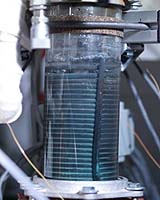
University Park PA (SPX) Apr 28, 2005 Using a new electrically-assisted microbial fuel cell (MFC) that does not require oxygen, Penn State environmental engineers and a scientist at Ion Power Inc. have developed the first process that enables bacteria to coax four times as much hydrogen directly out of biomass than can be generated typically by fermentation alone. Dr. Bruce Logan, the Kappe professor of environmental engineering and an inventor of the MFC, says, "This MFC process is not limited to using only carbohydrate-based biomass for hydrogen production like conventional fermentation processes. We can theoretically use our MFC to obtain high yields of hydrogen from any biodegradable, dissolved, organic matter -- human, agricultural or industrial wastewater, for example -- and simultaneously clean the wastewater. "While there is likely insufficient waste biomass to sustain a global hydrogen economy, this form of renewable energy production may help offset the substantial costs of wastewater treatment as well as provide a contribution to nations able to harness hydrogen as an energy source," Logan notes,. The new approach is described in a paper, "Electrochemically Assisted Microbial Production of Hydrogen from Acetate," released online currently and scheduled for a future issue of Environmental Science and Technology. The authors are Dr. Hong Liu, postdoctoral researcher in environmental engineering; Dr. Stephen Grot, president and founder of Ion Power, Inc.; and Logan. Grot, a former Penn State student, suggested the idea of modifying an MFC to generate hydrogen. In their paper, the researchers explain that hydrogen production by bacterial fermentation is currently limited by the "fermentation barrier" -- the fact that bacteria, without a power boost, can only convert carbohydrates to a limited amount of hydrogen and a mixture of "dead end" fermentation end products such as acetic and butyric acids. However, giving the bacteria a small assist with a tiny amount of electricity -- about 0.25 volts or a small fraction of the voltage needed to run a typical 6 volt cell phone -- they can leap over the fermentation barrier and convert a "dead end" fermentation product, acetic acid, into carbon dioxide and hydrogen. Logan notes, "Basically, we use the same microbial fuel cell we developed to clean wastewater and produce electricity. However, to produce hydrogen, we keep oxygen out of the MFC and add a small amount of power into the system." In the new MFC, when the bacteria eat biomass, they transfer electrons to an anode. The bacteria also release protons, hydrogen atoms stripped of their electrons, which go into solution. The electrons on the anode migrate via a wire to the cathode, the other electrode in the fuel cell, where they are electrochemically assisted to combine with the protons and produce hydrogen gas. A voltage in the range of 0.25 volts or more is applied to the circuit by connecting the positive pole of a programmable power supply to the anode and the negative pole to the cathode. The researchers call their hydrogen-producing MFC a BioElectrochemically-Assisted Microbial Reactor or BEAMR. The BEAMR not only produces hydrogen but simultaneously cleans the wastewater used as its feedstock. It uses about one-tenth of the voltage needed for electrolysis, the process that uses electricity to break water down into hydrogen and oxygen. Logan adds, "This new process demonstrates, for the first time, that there is real potential to capture hydrogen for fuel from renewable sources for clean transportation." Related Links Penn State SpaceDaily Search SpaceDaily Subscribe To SpaceDaily Express
 Analysis: Bush Energy Plan Fails To Excite
 Washington (UPI) April 28, 2005
The Bush administration is stepping up efforts to meet the nation's growing energy needs amid spiraling oil prices, but some analysts are skeptical about how effective the proposals will be to address the problem. |
|
|

| The content herein, unless otherwise known to be public domain, are Copyright 1995-2006 - SpaceDaily.AFP and UPI Wire Stories are copyright Agence France-Presse and United Press International. ESA PortalReports are copyright European Space Agency. All NASA sourced material is public domain. Additionalcopyrights may apply in whole or part to other bona fide parties. Advertising does not imply endorsement,agreement or approval of any opinions, statements or information provided by SpaceDaily on any Web page published or hosted by SpaceDaily. Privacy Statement |