| . |  |
. |
| . | |
. |


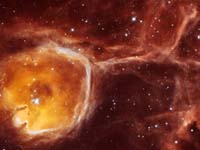
Hubble Peers Inside A Celestial Geode
Paris (ESA) Aug 13, 2004 Real geodes are handball-sized, hollow rocks that start out as bubbles in volcanic or sedimentary rock. Only when these inconspicuous round rocks are split in half by a geologist, do we get a chance to appreciate the inside of the rock cavity that is lined with crystals. In the case of Hubble's 35 light-year diameter 'celestial geode' the transparency of its bubble-like cavity of interstellar gas and dust reveals the treasures of its interior. The object, called N44F, is being inflated by a torrent of fast-moving particles (what astronomers call a "stellar wind") from an exceptionally hot star (the bright star just below the centre of the bubble) once buried inside a cold dense cloud. Compared with our Sun (which is losing mass through the so-called "solar wind"), the central star in N44F is ejecting more than a 100 million times more mass per second and the hurricane of particles moves much faster at 7 million km per hour (as opposed to less than 1.5 million km per hour for our Sun). Because the bright central star does not exist in empty space but is surrounded by an envelope of gas, the stellar wind collides with this gas, pushing it out, like a snow plough. This forms a bubble, whose striking structure is clearly visible in the crisp Hubble image. The nebula N44F is one of a handful of known interstellar bubbles. Bubbles like these have been seen around evolved massive stars (so-called Wolf-Rayet stars), and also around clusters of stars (where they are called "super-bubbles"). But they have rarely been viewed around isolated stars, as is the case here. On closer inspection N44F harbours additional surprises. The interior wall of its gaseous cavity is lined with several four to eight light-year high finger-like columns of cool dust and gas. (The structure of these "columns" is similar to the Eagle Nebula's iconic "Pillars of Creation" photographed by Hubble a decade ago, and is seen in a few other nebulae as well). The fingers are created by a blistering ultraviolet radiation from the central star. Like wind socks caught in a gale, they point in the direction of the energy flow. These pillars look small in this image only because they are much farther away from us then the Eagle Nebula's pillars. N44F is located about 160,000 light-years in the neighbouring dwarf galaxy the Large Magellanic Cloud, in the direction of the southern constellation Dorado. N44F is part of the larger N44 complex, which contains a large super-bubble, blown out by the combined action of stellar winds and multiple supernova explosions. N44 itself is roughly 1,000 light-years across. Several compact star-forming regions, including N44F, are found along the rim of the central super-bubble. This image was taken with Hubble's Wide Field Planetary Camera 2, using filters that isolate light emitted by sulphur (shown in blue, a 1,200-second exposure) and hydrogen gas (shown in red, a 1,000-second exposure). In this unusual image, the NASA/ESA Hubble Space Telescope captures a rare view of the celestial equivalent of a geode - a gas cavity carved by the stellar wind and intense ultraviolet radiation from a young hot star Related Links NASA/ESA Hubble Space Telescope SpaceDaily Search SpaceDaily Subscribe To SpaceDaily Express
 Instrument Aboard Hubble Space Telescope Suspends Operation
 Greenbelt MD (SPX) Aug 09, 2004
One of four science instruments aboard NASA's Hubble's Space Telescope suspended operations earlier this week, and engineers are now looking into possible recovery options. |
|
|

| The content herein, unless otherwise known to be public domain, are Copyright 1995-2006 - SpaceDaily.AFP and UPI Wire Stories are copyright Agence France-Presse and United Press International. ESA PortalReports are copyright European Space Agency. All NASA sourced material is public domain. Additionalcopyrights may apply in whole or part to other bona fide parties. Advertising does not imply endorsement,agreement or approval of any opinions, statements or information provided by SpaceDaily on any Web page published or hosted by SpaceDaily. Privacy Statement |