|
 |
 |
 |
 |
 |
 |
 |
 |
 |

| . |  |
. |
Hubble Adds Basic Shape To Comet Churyumov-Gerasimenko
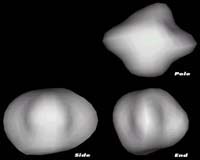
Paris - Sep 08, 2003 Results from the Hubble Space Telescope played a major role in preparing ESA's ambitious Rosetta mission for its new target, comet 67P/Churyumov-Gerasimenko. Hubble has been the critical tool in measuring precisely the size, shape and rotational period of the comet. Information that is essential if Rosetta is to rendezvous with a comet and then drop down a probe, something never before attempted and yet a major step to elucidating solar system origins. Hubble's observations from March 2003 revealed that comet 67P/Churyumov-Gerasimenko (67P/C-G) is approximately five-by-three kilometres, and shaped like a rugby ball on which it is possible to land. ESA Mission scientists were concerned about the exact size of the solid nucleus, which is needed to adapt the mission to the comet's gravity. "Although 67P/C-G is roughly three times larger than the original Rosetta target, its highly elongated shape should make landing on its nucleus feasible, now that measures are in place to adapt the lander package to the new scenario," says Dr. Philippe Lamy of the Laboratoire d'Astronomie Spatiale in France. Lamy presented the Hubble results on comet 67P/C-G at the annual meeting of the Division of Planetary Sciences of the American Astronomical Society in California, USA, on 5 September 2003. Mission scientists began considering the new target when the Rosetta mission's launch date was postponed. The delay made the original target comet, 46P/Wirtanen, no longer easily reachable. But scientists did not have enough information on the backup comet, 67P/C-G, and sought data from the largest telescopes. Using a technique developed over the past decade by Lamy, Imre Toth (Konkoly Observatory, Hungary), and Harold Weaver (Johns Hopkins University Applied Physics Laboratory, Laurel, USA), the team snapped 61 Hubble images of comet 67P/C-G over an interval of 21 hours between March 11 and 12, 2003. Hubble's Wide Field Planetary Camera 2 isolated the comet's nucleus from the coma, the diffuse cloud of gas and dust surrounding the nucleus, and quickly providing the missing figures. The telescope showed that the nucleus is ellipsoidal and also measured its rotation rate of approximately 12 hours. Rosetta's launch is currently planned for February 2004, with a rendezvous with the comet about 10 years later. The team is composed of P.L. Lamy and L. Jorda (Laboratoire d'Astronomie Spatiale, France), I. Toth (Konkoly Observatory, Hungary), and H.A. Weaver (Johns Hopkins University Applied Physics Laboratory). The movie simulation of the Hubble results is provided by Mikko Kaasalainen (University of Helsinki, Finland) and Pedro Gutierrez (Laboratoire d'Astronomie Spatiale, France). The observations were made possible through a special program approved by the Director of the Space Telescope Science Institute, S. Beckwith. Image credit: NASA, European Space Agency and Philippe Lamy (Laboratoire d'Astronomie Spatiale, France) Related Links Animations based on Hubble image data Hubble at ESA SpaceDaily Search SpaceDaily Subscribe To SpaceDaily Express
 High-Resolution Images of Asteroid (511) Davida
 Monterey - Sep 08, 2003
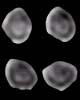
A team of scientists from the W.M. Keck Observatory and several other research institutions have made the first full-rotational, ground-based observations of asteroid (511) Davida, a large, main-belt asteroid that measures 320 km (200 miles) in diameter.
--------------------------------------------------------- It's new. And it's downright terrific! Celestron's CPC Schmidt-Cassegrain telescope is the scope you've been waiting for! It offers new alignment technology, advanced engineering, and bold new design at a new, low price! In fact, Celestron's Professional Computerized (CPC) scope with revolutionary SkyAlign Alignment Technology redefines everything that amateur astronomers are looking for. It offers quick and simple alignment, GPS technology, unsurpassed optical quality, ease of use, advanced ergonomics, enhanced computerization and, most important, affordability. Want to view M-31 tonight? One button takes you there!
Shop for telescopes online at Telescopes.com! today!
|
|
|

| The content herein, unless otherwise known to be public domain, are Copyright 1995-2006 - SpaceDaily.AFP and UPI Wire Stories are copyright Agence France-Presse and United Press International. ESA PortalReports are copyright European Space Agency. All NASA sourced material is public domain. Additionalcopyrights may apply in whole or part to other bona fide parties. Advertising does not imply endorsement,agreement or approval of any opinions, statements or information provided by SpaceDaily on any Web page published or hosted by SpaceDaily. Privacy Statement |