|
 |
 |
 |
 |
 |
 |
 |
 |
 |

| . |  |
. |
High Speed Space-Tech Cooling Creates New Era In Cosmetics
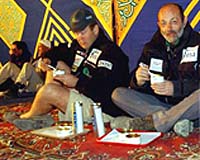
Paris, France (ESA) Sep 22, 2004 Cool your product from 22� C to 2� C in just two minutes with no electricity, simply by 100% natural evaporation, using an advanced simulation technique from Europe's Ariane launcher. "We have managed to develop a controlled fast cooling system, without the use of outside energy, where the temperature drops 70 times faster than in a standard refrigerator," says Fadi Khairallah, founder of Thermagen, the company behind this innovation. "By using vacuum evaporation our process absorbs the heat energy of the product, thereby cooling it at high speed whenever required. To determine the control of the vacuum water evaporation process we used a simulation technique from the space industry." The same advanced simulation code is used to simulate the operation of the Ariane rocket engines. Thermagen gained access to this advanced simulation tool through ESA's Technology Transfer Programme. The tool enabled them to model the complex physical phenomena that take place inside the self-refrigerating system, and to design a general purpose product to cool anything whenever required. "Using this we managed to optimize the performance and reliability of our cooling system, to reduce the temperature by 20� C within minutes," adds Khairallah. Actually this cooling principle has been known for thousands of years. Porous jugs and gourd skins were used in the past because they cooled their contents by surface evaporation. "Our system can be compared to the way the human body controls its temperature by perspiration," explains Khairallah. "The refrigeration technique used, named the Sorption cooling, has actually been known since the thirties but it never went out from laboratories in a single-to-use disposable packaging form." The first time this cooling technique was tried 'in real life' was during the Dakar Rally in January 2003 when Thermagen provided self-cooling containers to chill drinks for the Pescarolo Sports rally team. By evaporating one centilitre of water under vacuum sustained by special ceramics, the temperature of the drink in the container was reduced by 15� C. "Now we are using the same principle for an exceptional new skincare product developed with our partner Cosnessens, 'Ice Source', which takes advantage of this ultra-fast cooling effect," says Khairallah. "The combination of the ultra-fast cooling with a special set of skincare ingredients, including a rare extract of Arctic raspberry, provides an immediate lifting effect when applied on the skin." The effect of rapid cooling of skin care products is already well known to cosmetics researchers. When cooled by more than 5� C per minute, lipids (fats, oils, waxes, etc.) which are the basic material in cosmetic products undergo molecular retraction, which make them penetrate the skin better � known as 'the quenching effect'. Once absorbed by the skin, they regain their initial structure and 'fill up' with water. The result is that they integrate faster and affect the skin immediately. Until now, the technological means to generate and control this super-cooling effect was not available. With the help of space simulation software which was developed for the European launcher Ariane's rocket engines, Thermagen has managed to control the super-cooling effect and to optimise the performance of a miniaturised packaging. "Improving the efficiency of cosmetics is definitely not the most obvious use of our technology from spacecraft launchers, but after more than 200 transfers of space technologies, I have learnt that space can provide the most astonishing solutions to everyday life on Earth," says Pierre Brisson, Head of ESA's Technology Transfer and Promotion Office. "Already during the Dakar Rally we saw that Thermagen had developed an innovative solution using our space techniques to cool drinks very fast � this turned out to be a great triumph in the Saharan heat. I am sure that this transfer, the 'Ice Source�', will be equally successful." Thermagen and its partners Cosnessens and Eurosphere presented this innovative skin care product in a special launching event in Paris on 21 September 2004. Related Links Thermagen Cosnessens SpaceDaily Search SpaceDaily Subscribe To SpaceDaily Express
 Genesis Board Turn Over Surviving Science Package To Scientists
 Dugway (SPX) Sep 21, 2004
The NASA Genesis Mishap Investigation Board (MIB) arrived at Dugway Proving Ground (DPG), Utah, September 10, to take charge of the investigation. The Genesis Sample Return Capsule (SRC) impacted the ground after its drogue and parafoil systems failed to deploy during re-entry September 8. Dr. Michael Ryschkewitsch is the leader of the MIB. |
|
|

| The content herein, unless otherwise known to be public domain, are Copyright 1995-2006 - SpaceDaily.AFP and UPI Wire Stories are copyright Agence France-Presse and United Press International. ESA PortalReports are copyright European Space Agency. All NASA sourced material is public domain. Additionalcopyrights may apply in whole or part to other bona fide parties. Advertising does not imply endorsement,agreement or approval of any opinions, statements or information provided by SpaceDaily on any Web page published or hosted by SpaceDaily. Privacy Statement |